What Snow Load Does a Patio Cover Need in Twin Falls?
The city requires a 25 psf minimum design roof load and the county's ground snow load is 30 psf. What those numbers mean, why a brochure rating is not one, and the questions to ask a contractor.
TL;DR
- Inside Twin Falls city limits: ground snow load is 15 psf, with a minimum uniformly distributed design roof load of 25 psf required by local ordinance.
- In unincorporated Twin Falls County: ground snow load is 30 psf, double the city figure.
- Both use 115 mph design wind and a 24-inch frost depth. The county sits at exposure C, the city at exposure B with some areas at C.
- Big-box louvered kits are commonly rated in the 8 to 18 psf range. That's below the city's minimum before you even consider a county address.
- A brochure number is a ceiling, not a property. Published maximums describe standard configurations. Your span, your exposure and your address produce a different number.
- The peak snow rating on a louvered roof is usually measured with the louvers open. Closed is the rain setting, not the snow setting.
- Snow and wind arrive together. A structure that handles each load separately can fail under both at once.
Ask three contractors what snow load your patio cover needs in Twin Falls and you can get three answers. That's not because the requirement is vague. It's because most people quoting it have never looked it up, and because the honest answer starts with a question about your address.
Here are the actual published numbers, what they mean, and how to check whether a quote respects them.
The number depends on which side of the city line you're on
Twin Falls has two separate building programs. The City of Twin Falls Building Safety Department handles permits and inspections inside city limits. Twin Falls County Community Development Services handles unincorporated county property. They publish different design criteria.
Inside city limits, the residential design criteria set a ground snow load of 15 psf, with a minimum uniformly distributed design roof load of 25 psf required by local ordinance. Design wind speed is 115 mph gust, exposure category B with some areas at C, seismic design category B, presumed soil bearing of 1500 psf without a soils investigation, frost depth 24 inches, climate zone 5B.
In unincorporated Twin Falls County, ground snow load is 30 psf. Design wind is also 115 mph three-second gust under the IRC, at exposure coefficient C, with seismic design category C, a design temperature of zero degrees Fahrenheit, frost line at 24 inches, and maximum soil bearing of 1500 psf. The county has adopted the 2018 IBC, IRC, IECC, IMC, IFGC, IEBC and IFC with Idaho amendments.
So a home out toward Filer or on the rim sits under a heavier ground snow requirement than one on Addison Avenue, in a more exposed wind category. A Twin Falls mailing address does not tell you which set applies. If you aren't certain, call before you design anything. City: (208) 735-7238. County: (208) 734-9490.
Ground snow load and design roof load are not the same thing
This trips up homeowners constantly, and some contractors too.
Ground snow load is a regional value describing how much snow weight accumulates on flat ground at your location. It's an input, not a requirement for your roof.
Design roof load is what the structure above your head actually has to carry. It's derived from the ground snow load through factors covering exposure, thermal condition, roof slope, drift potential and importance. Depending on those factors, a roof load can come out lower or considerably higher than the ground number.
That's why the city publishes both: a ground snow load of 15 psf, and then a separate local ordinance requiring a minimum design roof load of 25 psf regardless. The ordinance sets a floor.
It also means you cannot take the county's 30 psf ground figure and assume your roof needs exactly 30. It needs whatever the engineering produces for your specific structure, and the ground load is where that calculation starts.
The kit math nobody runs
Walk into a big-box store and you'll find louvered pergola kits at attractive prices. The number you won't find printed anywhere prominent is the snow rating. When it is published, these kits commonly land somewhere in the 8 to 18 psf range.
Line that up against a 25 psf minimum design roof load inside the city and the problem is obvious before you get to a county address with a 30 psf ground load.
This isn't a claim that every kit is dangerous, and it isn't an argument that expensive always means engineered. It's an argument for asking one question before you buy anything: what is this structure rated to carry, and who calculated it. A kit that ships from a warehouse has a rating from the factory for a standard configuration. It has never seen your patio.
A published rating is a ceiling, not a property
This is the part we'd push back on across the whole industry, our own marketing included.
Manufacturers publish maximum ratings. The Azenco R-BLADE we install is published at up to 100 psf snow and up to 190 mph wind, and it carries a Miami-Dade Notice of Acceptance. The manual K-BANA is published at up to 25 psf snow and around 105 mph wind, though you'll find different wind figures on different dealer sites. Other systems in the category publish ranges that vary by elevation and location.
Every one of those numbers describes what a standard configuration can achieve. None of them describes what your structure, at your span, in your exposure category, on your site, is engineered to hold. Widen a bay, extend a span, change the attachment, and the number moves.
You'll also find the same product advertised with different figures by different dealers, which tells you something useful about how loosely these numbers travel.
The practical takeaway: when a contractor answers "what snow load is this rated for" with a single number and no follow-up questions, they're reading a brochure. The right answer involves your address.
The open-versus-closed surprise
Here's the fact that catches nearly every homeowner.
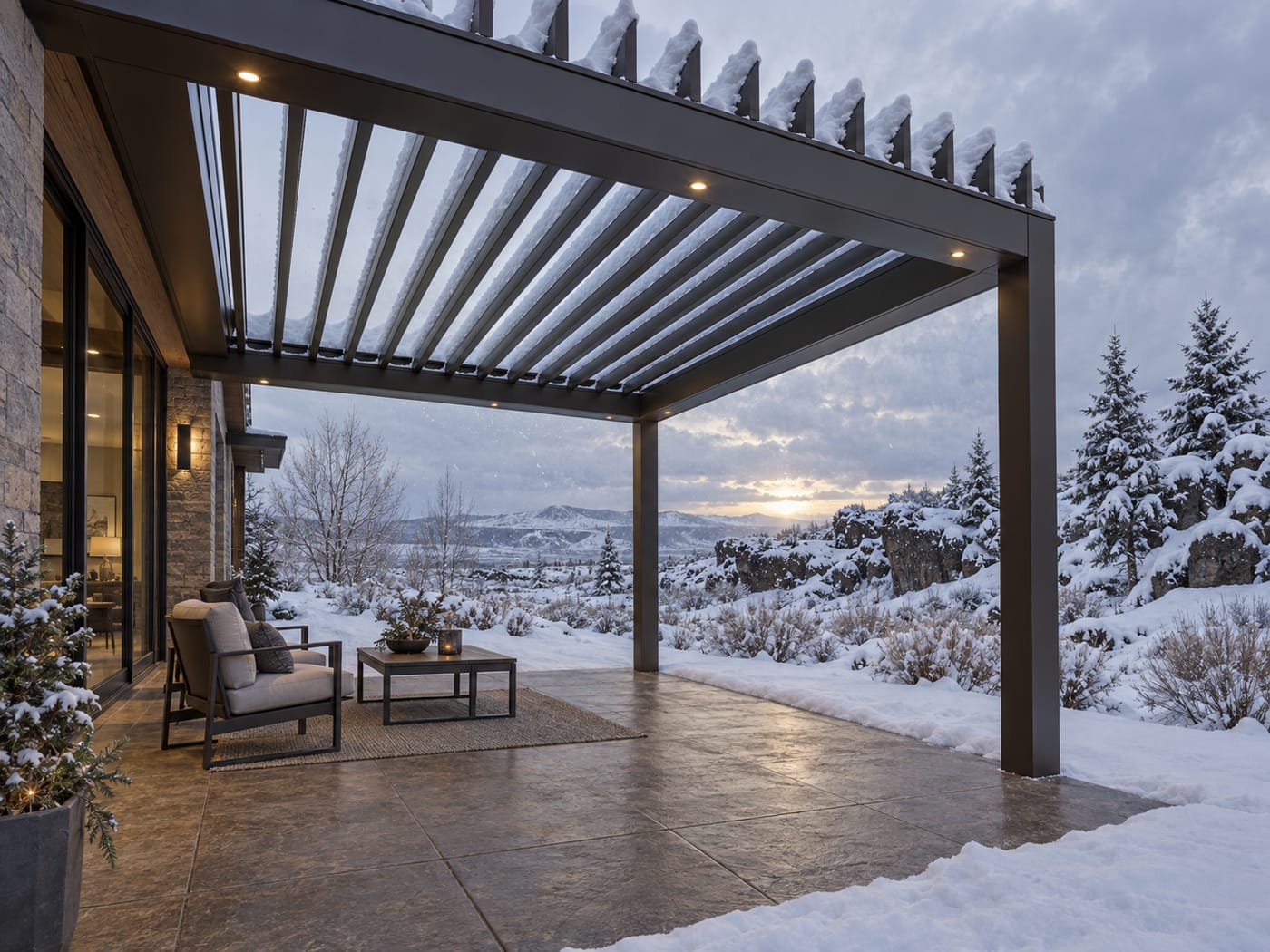
On a louvered roof, the peak snow rating is generally measured with the louvers open. Azenco's temperature sensor is designed to open the roof in freezing conditions specifically to prevent snow and ice buildup. Other manufacturers in the category advise keeping louvers open during heavy snowfall so snow falls through rather than accumulating.
Closed is the rain setting. It's what keeps your dinner dry. It is generally not the snow setting, because a sealed plane collects and holds load in a way an open one does not.
If you've been told to close the roof before a winter storm to protect it, check that against your system's documentation. This is the single most common operating misunderstanding with these structures, and getting it wrong is the kind of thing that turns into a warranty conversation.
Loads arrive together
One more thing that a single number can't capture.
Structural design doesn't evaluate snow and wind in isolation. Load combinations require a structure to resist them simultaneously, which means a cover rated to handle a given wind speed on a clear day and a given snow load on a calm day can still fail when both show up at once. A wet snow driven by a 60 mph wind is a different problem than either load alone.
On a louvered roof there's an added wrinkle: wind rating depends on louver position, since open louvers let air pass through while closed louvers present a solid plane resisting the full force. That's why wind sensors on motorized systems are set to open the louvers rather than close them.
There's also a units problem
Twin Falls publishes design wind as a 115 mph three-second gust. Many product wind ratings are expressed as sustained wind speed. Those are different measurements, and comparing one directly against the other produces a conclusion that looks rigorous and isn't.
If a quote tells you a product's wind rating exceeds the local requirement, it's fair to ask which measurement each number uses.
How to check a quote
Four questions will tell you more than any spec sheet:
- What design roof load is this structure engineered to, at my address? Not the product's maximum. Mine.
- Who did that calculation, and can I see it? Engineered structures come with stamped drawings.
- Which exposure category did you use? The city is largely B with some areas C. The county is C. It changes the math.
- What certification does the product carry? An ICC-ES evaluation report or a Miami-Dade NOA both give a plan reviewer something real to look at.
A contractor who welcomes those questions is a contractor who has answered them before.
Get the number for your address
Every property here is different, and the city line matters more than most people expect. A free design consultation covers your span, your exposure, your site conditions, and what your specific address actually requires.
Book a Free Design Consultation or call (208) 731-1729
Frequently asked questions
What is the snow load requirement for a patio cover in Twin Falls? Inside city limits, published residential design criteria set a ground snow load of 15 psf and require a minimum uniformly distributed design roof load of 25 psf by local ordinance. In unincorporated Twin Falls County, ground snow load is 30 psf. Your structure's actual required design load comes from engineering for your specific site, so confirm it for your address.
Why is the county number higher than the city number? They're separate jurisdictions publishing separate design criteria, and the county also sits at exposure category C rather than the city's predominantly B. Different terrain and exposure produce different requirements.
Is a 25 psf rating enough? Inside city limits it meets the published minimum, which means it satisfies the floor with no margin above it. Whether that's appropriate for your structure depends on span, exposure, drift potential and attachment, which is what the engineering determines. For a county property with a 30 psf ground snow load, it deserves a closer look.
Should I close my louvers before a snowstorm? Usually not. Peak snow ratings on louvered roofs are generally measured with the louvers open, and manufacturers commonly advise opening them in freezing conditions so snow falls through instead of building up on a sealed surface. Follow your system's documentation rather than assuming closed means protected.
Can I use a big-box pergola kit here? Check its published snow rating first. Kits in that category commonly fall in the 8 to 18 psf range, which sits below the city's 25 psf minimum design roof load. Some structures may still be permissible depending on size, configuration and whether a permit applies, but the rating is the first thing to look at, not the price.
Do I need an engineer's stamp? For a permitted structure, plan review will want to see that the design meets local criteria. Engineered systems come with stamped drawings. Ask to see them before you sign rather than after.
What about wind? Twin Falls uses a 115 mph three-second gust design wind, and the county is at exposure C. Product ratings are often published as sustained wind, which is a different measurement. Ask which one a quoted figure refers to, and remember that snow and wind loads are evaluated together rather than separately.
This article is general guidance for the Twin Falls area, not a code ruling, and published product ratings are not a substitute for site-specific engineering. Confirm requirements for your property with City of Twin Falls Building Safety at (208) 735-7238 or Twin Falls County Community Development Services at (208) 734-9490 before you build.