What a Patio Cover Actually Costs in Twin Falls (2026)
The $2,000 estimate you find online is pricing a 215 sq ft metal awning, not a permitted structure. Real 2026 ranges, what Twin Falls frost depth and snow load add, and how to compare two quotes.
TL;DR
- The number you find first is wrong. A lead-generation site currently lists Twin Falls patio covers at $1,855 to $2,488, or $9 to $12 per square foot. Read the detail and that figure is for a 215 square foot metal awning.
- Real 2026 numbers: a patio cover over an existing patio runs about $20 to $60 per square foot nationally, and aluminum specifically about $20 to $50 per square foot installed.
- Louvered roofs are priced separately and they are the expensive part: roughly $45 to $110 per square foot for manual, $55 to $125 for motorized, and $75 to $175 for motorized with sensors and scheduling.
- Twin Falls adds cost before anyone picks a product. Footings below 24 inches of frost depth, a 25 psf minimum design roof load in the city, 30 psf ground snow in the county, and a permit for any electrical.
- Our motorized pergolas run $25,000 to $50,000 and up, with a manual louvered line starting near $9,999. That is higher than the national middle, and the reasons are specific.
- We are the only company in this market publishing numbers at all.
Search what a patio cover costs in Twin Falls and the first real figure you will see is somewhere around $2,000.
That number is not made up, but it is not describing what you are shopping for. One national lead-generation site currently lists a Twin Falls typical range of $1,855 to $2,488, updated in August 2026, at $9 to $12 per square foot. Look at what it is actually pricing and the answer is a 215 square foot metal awning. The same page suggests a typical patio cover runs $300 to $2,000.
An awning is a strip of metal over a door. A patio cover is a permitted structure with footings, engineered to carry snow. Pricing one from the other is like quoting a carport from the price of an umbrella.
Here is what the real numbers look like, why this market costs more than the national middle, and why our range starts where it does.
The actual 2026 market
National cost data for this year puts a patio cover over an existing patio at roughly $20 to $60 per square foot. Aluminum specifically lands around $20 to $50 per square foot installed, which works out to about $4,000 to $10,000 for a 10 by 20 foot cover. A full covered patio, including the patio surface itself, runs $50 to $150 per square foot, or roughly $10,000 to $22,500 for 200 square feet.
Louvered roofs are priced as a separate line, and they are where the money goes. On top of a base structure at $10 to $65 per square foot, the roof adds roughly:
- $45 to $110 per square foot for a manual louvered roof
- $55 to $125 per square foot for a motorized one
- $75 to $175 per square foot for motorized with weather sensors and programmable scheduling
Then there are the line items people forget. A new slab or footings adds $4 to $30 per square foot. Drainage work runs $1,000 to $4,000. Gutters are $12 to $25 per linear foot. Outlets are $180 to $350 each and light fixtures $80 to $300. Screens add $10 to $25 per square foot. Installation labor generally runs $50 to $120 per hour.
So the honest national answer for a real covered structure is somewhere between $4,000 and well past $30,000, depending almost entirely on what the roof does.
What Twin Falls adds before you pick anything
Local conditions set a floor under the price here, and they apply to every contractor equally.
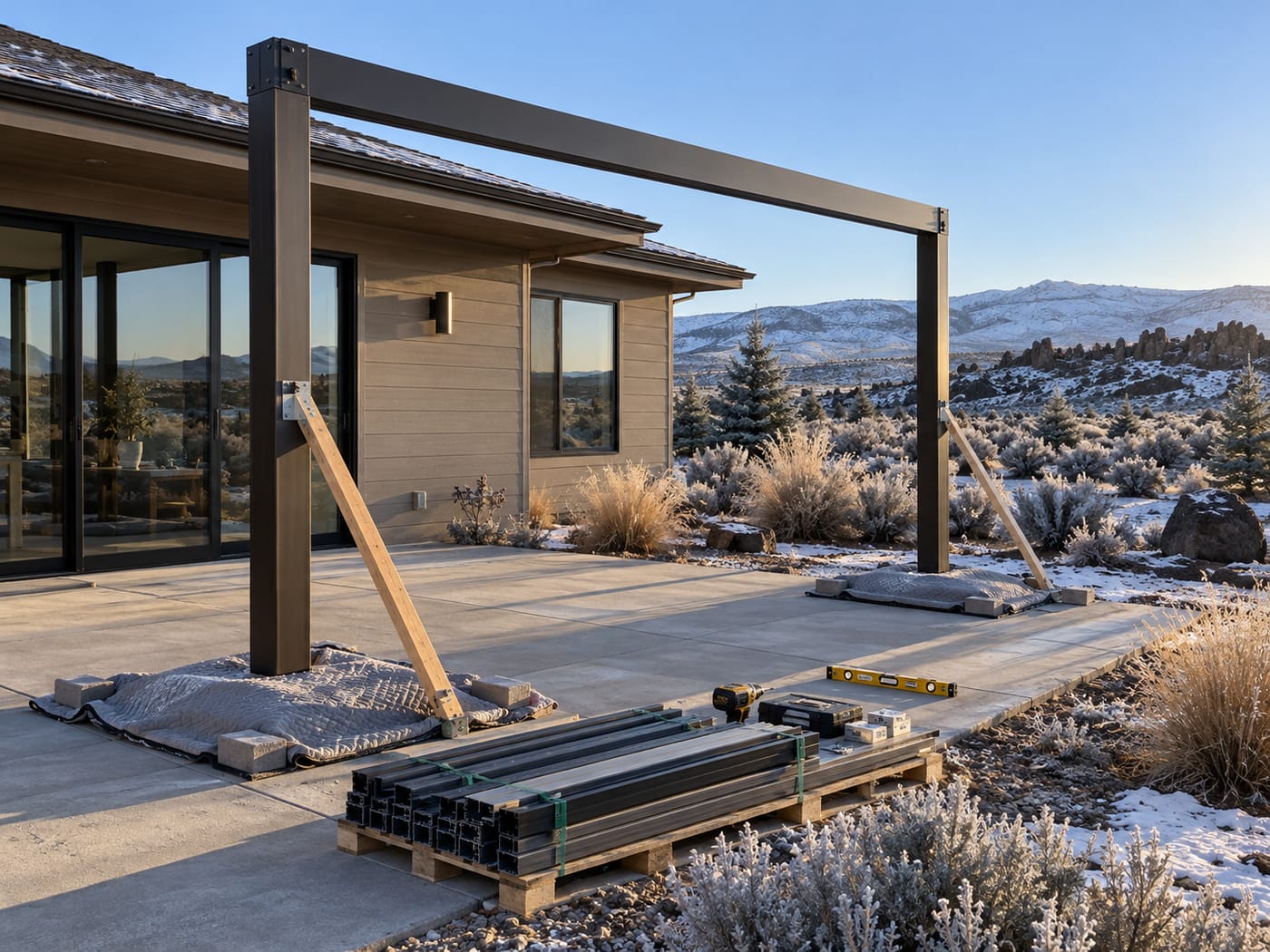
Footings. Frost depth is 24 inches in both the City of Twin Falls and Twin Falls County. Posts have to reach below it, which means excavation and concrete on every project, not just the ambitious ones. Shallow footings heave, and a heaved post racks the whole frame.
Snow. Inside city limits, the published residential design criteria set a ground snow load of 15 psf with a minimum uniformly distributed design roof load of 25 psf by local ordinance. In unincorporated Twin Falls County, ground snow load is 30 psf. Both design to a 115 mph wind, and the county sits at exposure category C. A structure engineered to carry that is not built the same way as one shipped from a warehouse. We go deeper on this in our guide to patio cover snow load in Twin Falls.
Permits. Inside the city, a permit is required for all electrical work with no size threshold, so anything with a motor or a light is permitted work by definition. In the county, the structure goes through Community Development Services while electrical routes to the state, and since September 2025 the county has charged a plan review fee equal to 35 percent of the building valuation fee, payable at submittal and non-refundable once review is done. Our permit guide covers the full split.
None of that is optional, and none of it shows up in a $9 per square foot estimate.
Why our range starts higher, in plain terms
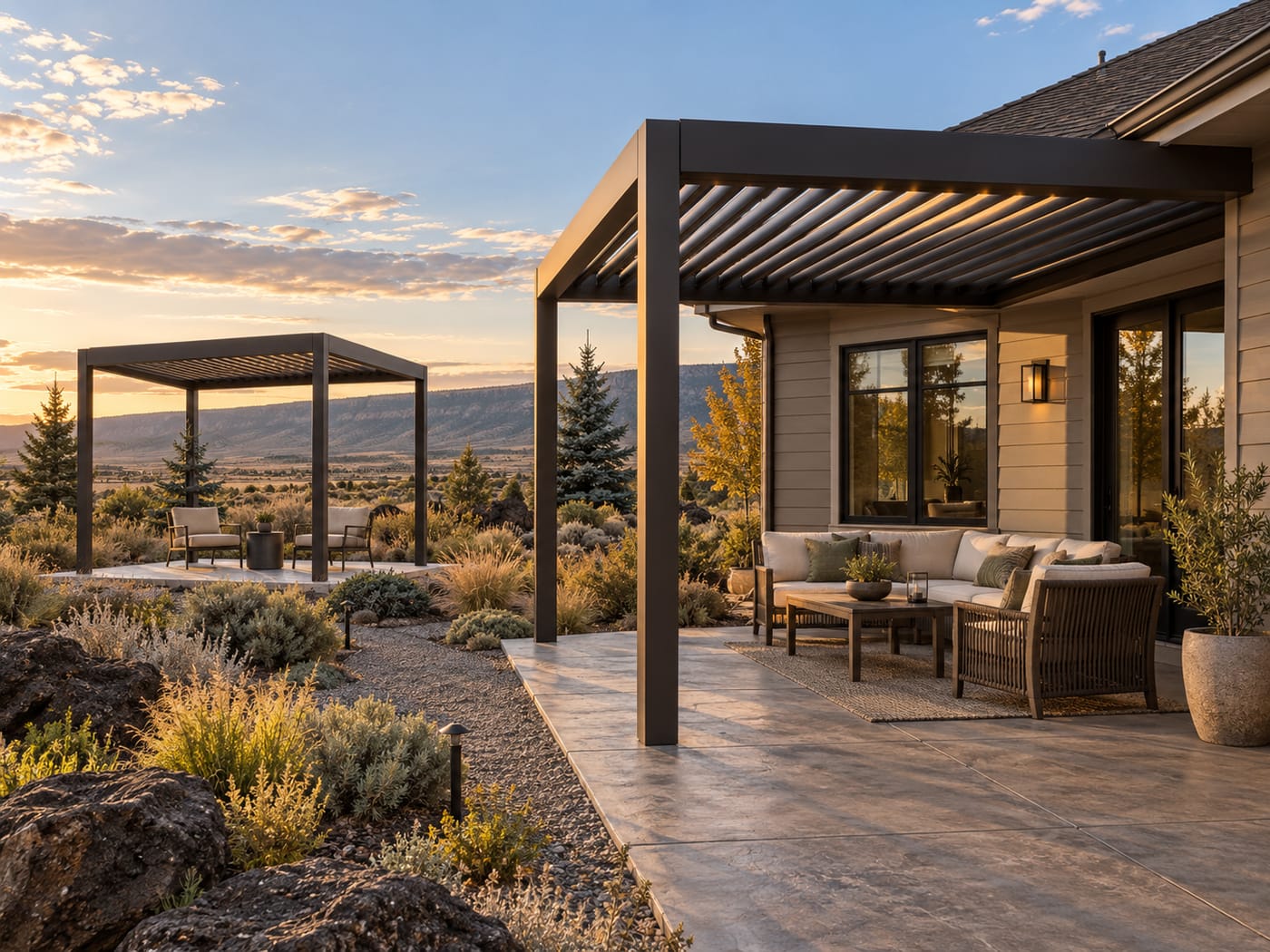
We publish $25,000 to $50,000 and up for motorized pergolas, with our manual louvered line starting near $9,999. Compare that to a national figure of $6,500 to $18,000 for an attached louvered pergola and the gap is fair to ask about.
Three things explain most of it.
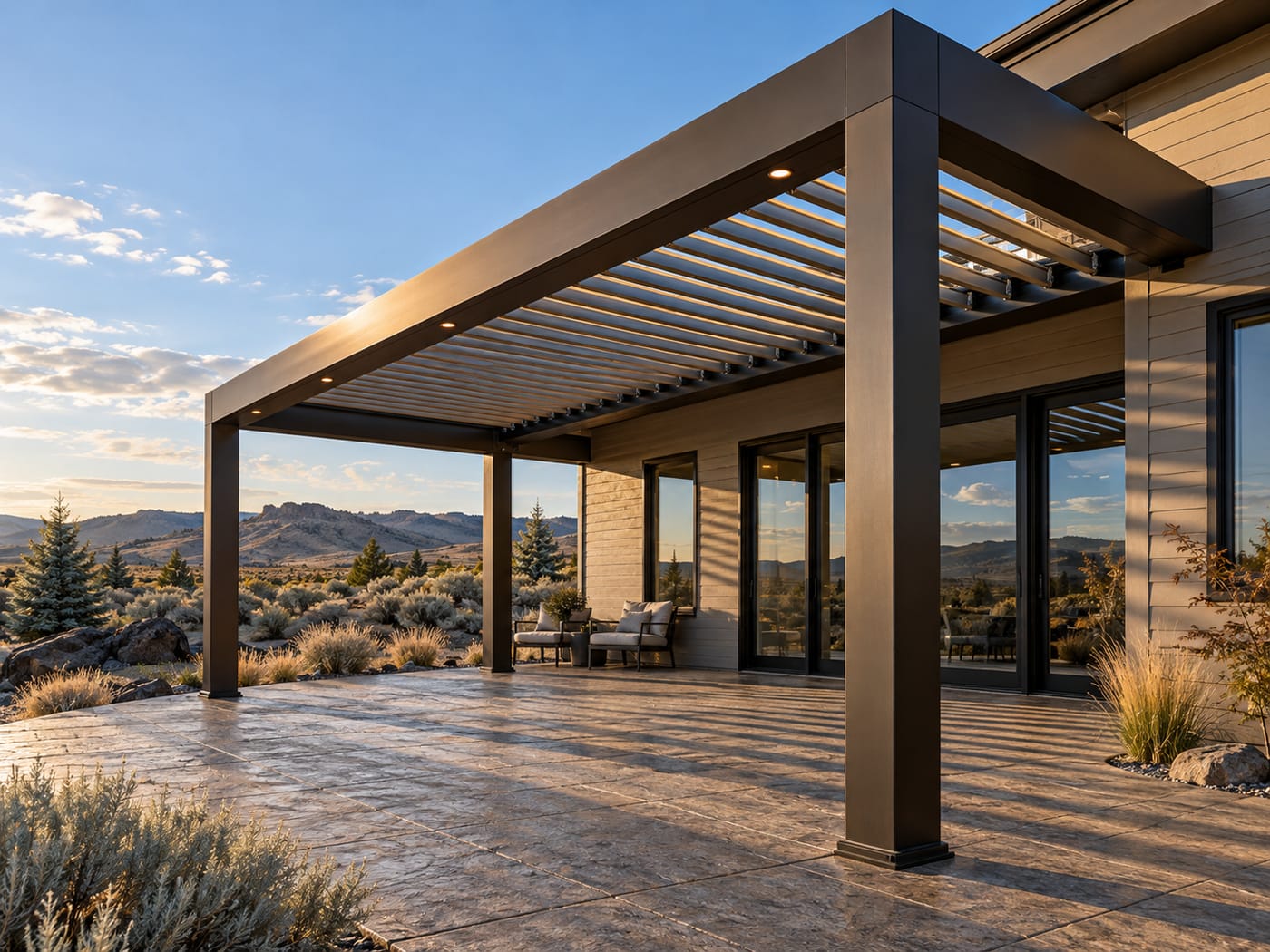
Product tier. A louvered pergola at the bottom of the national range and the Azenco R-Blade we install are both aluminum roofs with rotating blades, and that is where the similarity ends. Published ratings, blade construction, motor sealing, integrated through-post drainage and certification all differ. That matters more in a 30 psf county than it does in a mild climate.
Engineering for your address. Published maximums describe what a standard configuration can achieve. The number that governs your build comes from a calculation using your span, your exposure category and your site. That work costs money and it appears on the invoice.
Scope. Our number includes permitting, footings, electrical and inspections handled in house. A quote that covers a roof dropped onto an existing slab is a different scope, and the difference tends to surface later as change orders.
And the honest part: if a simpler structure fits your space and your use, it may be the right answer. That is exactly why we carry a manual louvered line starting near $9,999 rather than only the top of the range. We would rather quote you the smaller thing than sell you the larger one. Our comparison of motorized versus manual louvered pergolas walks through which is which.
What actually moves your number
If you are trying to build a budget before you call anyone, these are the variables in rough order of how much they matter.
Roof type. The single largest factor. A solid or lattice cover, a manual louvered roof and a motorized louvered roof with sensors are three different price tiers, and the spread between them is wider than the spread between a small project and a large one.
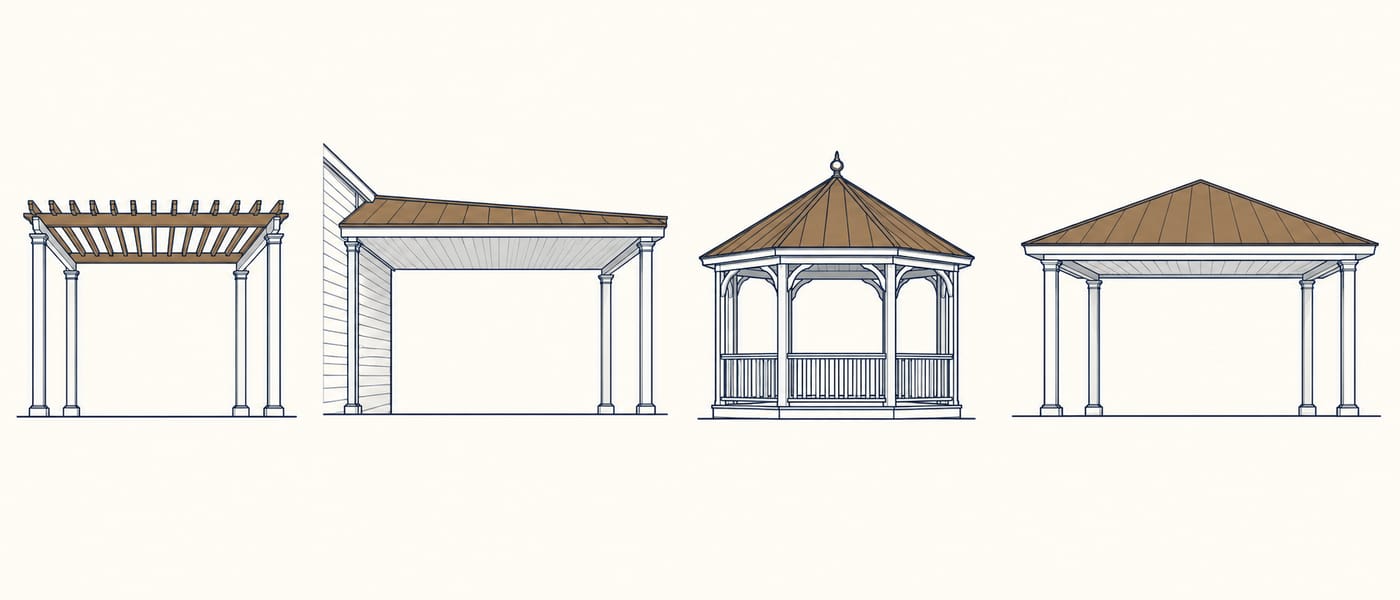
Span and square footage. Cost per square foot climbs faster than the area does. Longer spans between posts need heavier blade profiles and beefier structure, so a 20 foot clear span is not simply twice a 10 foot one. Adding a post is often cheaper than engineering the span to avoid it, which is a tradeoff worth discussing rather than assuming.
Attached or freestanding. Freestanding needs four posts and four independent footings instead of two, which is more excavation and more concrete. Attached needs a structural connection and proper flashing, and in snow country it may need to be engineered for load shed off the roof above.
Site conditions. Rock changes excavation, and the canyon rim has plenty of it. So does access. A back yard a mini excavator can reach costs less to work in than one where everything arrives by wheelbarrow.
Electrical scope. A motor is the start. Lighting, heaters, fans and screens each add circuits, and in the city every one of them is permitted work.
Add-ons. Screens, heat, integrated lighting and fire features are usually priced separately, and they are the easiest place for two quotes to diverge without either one being wrong.
How to compare quotes
Two bids that look $8,000 apart are usually describing two different products. Ask every one of them for the same five things: the structure's engineered design load at your address rather than the product's maximum rating, blade material and gauge, the motor manufacturer, warranty terms broken out separately for structure, motor and finish, and who is responsible for pulling permits.
Then check what is excluded. Footings, electrical, permits and site prep are the four items most often left off a low bid, and they do not stop being necessary just because they are missing from the page.
For what it is worth, no other outdoor living company in this market publishes pricing at all. We would rather give you a range you can plan around and then quote your project exactly.
Get a real number for your space
Ranges are for planning. A free design consultation gets you an itemized quote for your actual span, exposure and site, plus an honest answer about which build path fits. Financing is available with $0 down and a soft credit check that will not affect your score.
Book a Free Design Consultation or call (208) 731-1729
Frequently asked questions
Why do online estimates say a patio cover costs $2,000 in Twin Falls? Because they are pricing a different product. The most visible local estimate works out to $9 to $12 per square foot for a 215 square foot metal awning. National 2026 data puts aluminum patio covers at $20 to $50 per square foot installed, and that is before a louvered roof, footings or permits. The low number is real, it just is not describing a permitted structure engineered for Idaho snow.
What does a motorized louvered pergola cost in the Magic Valley? Ours generally run $25,000 to $50,000 and up depending on span, configuration and site conditions, with a manual louvered line starting near $9,999. Nationally, the louvered roof alone adds roughly $55 to $125 per square foot motorized, on top of the base structure, which is why the totals climb quickly.
Why is one quote $8,000 more than another? Usually because they are different products or different scopes. Check blade gauge, motor manufacturer, the engineered design load for your address, warranty terms separated by structure, motor and finish, and whether permits, footings and electrical are included or excluded.
How much do permits add? It varies with project valuation, since fees are calculated from it rather than from a flat rate. In the county, plan review alone adds 35 percent of the building valuation fee. The more useful question is who handles it. A licensed contractor should pull permits in their own name, and unpermitted work that gets caught is more expensive than permitting it was.
Can I finance a patio cover? Yes. Qualified homeowners can finance with $0 down and a soft credit check that will not affect their score, which for many projects works out to less than a car payment.
Figures in this article include 2026 national cost data and our own published ranges, current at the time of writing. Material costs and local requirements change, so confirm pricing for your project. For permit requirements, contact City Building Safety at (208) 735-7238 or Twin Falls County Community Development Services at (208) 734-9490.