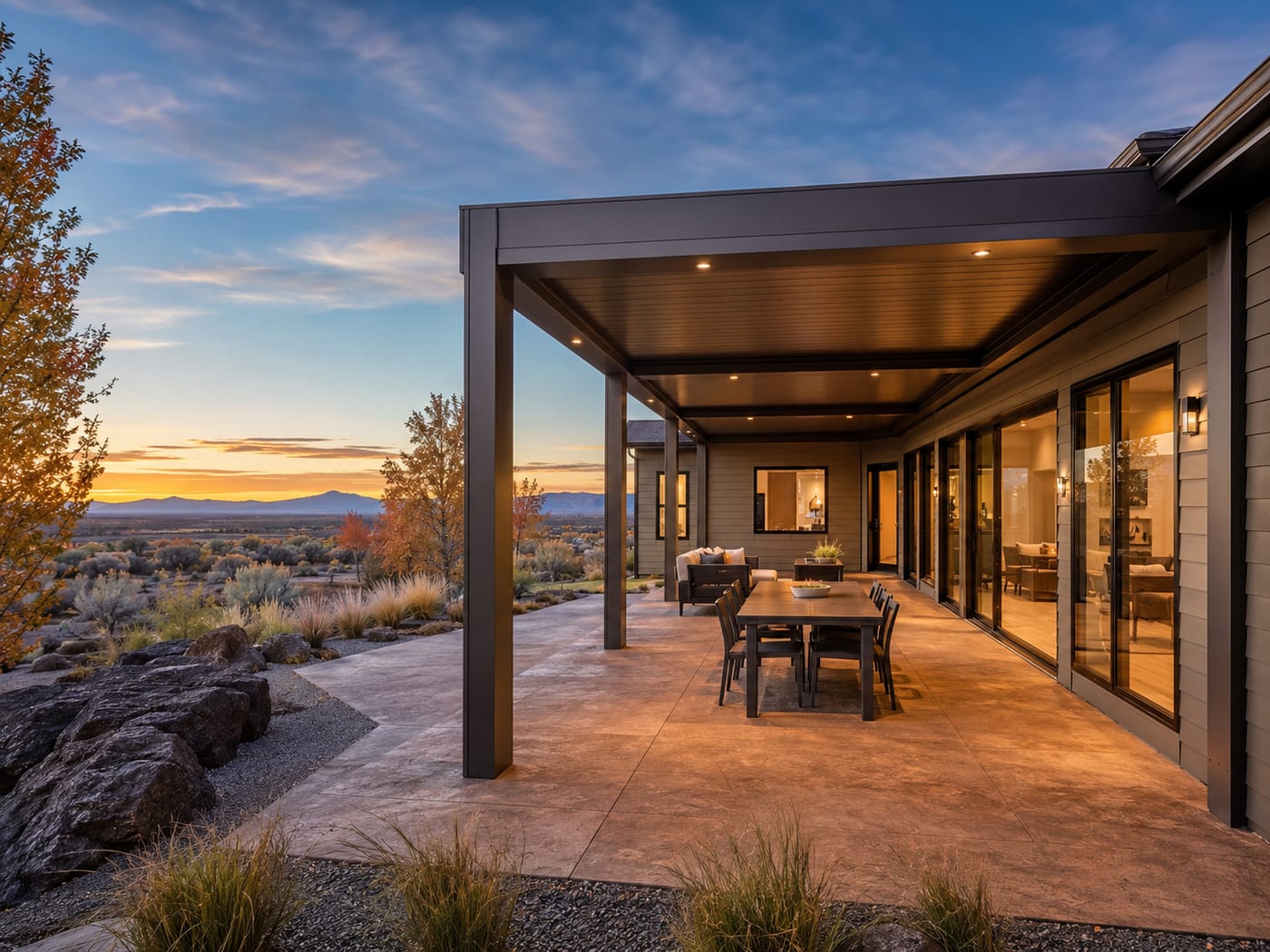
How Motorized Louvered Pergolas Work and Cost in Idaho
How the linkage, motor and weather sensors work, what a louvered roof costs in Idaho, and why the manufacturer opens the louvers in snow instead of closing them. Plus real Twin Falls numbers.
TL;DR
- A louvered roof is aluminum blades on pivot pins, all driven together by one linkage bar. A motor moves the bar. That's the whole concept.
- Three positions matter: fully open for airflow, tilted around 30 to 40 degrees for filtered sun, fully closed for rain.
- Closed is not the winter setting. Azenco's own temperature sensor opens the roof in freezing conditions to prevent snow and ice buildup. This surprises almost everyone.
- Sensors are the feature that earns its price. Rain, wind and freeze response is the reason to motorize at all.
- Cost in the Magic Valley: entry louvered systems start around $9,999, and full motorized pergola projects generally run $25,000 to $50,000 and up.
- A motorized pergola always needs a permit in Twin Falls. The city requires one for all electrical work with no size exemption. A motor is electrical.
- Snow load here is 25 psf minimum design roof load in the city and 30 psf ground snow in the county. Frost depth is 24 inches in both.
If you've ever set the table on your back patio in July and retreated indoors twenty minutes later because the sun turned your deck into a griddle, you already understand the appeal of a roof you can adjust.
Idaho weather doesn't do moderate. High desert sun, sudden afternoon storms, late-summer wildfire smoke, and winter loads that flatten a fabric canopy. A motorized louvered pergola answers that by giving you a roof with settings.
The question we hear most often is simply how the thing works. Here's the practitioner's answer, plus what it actually costs here.
How the louvers work
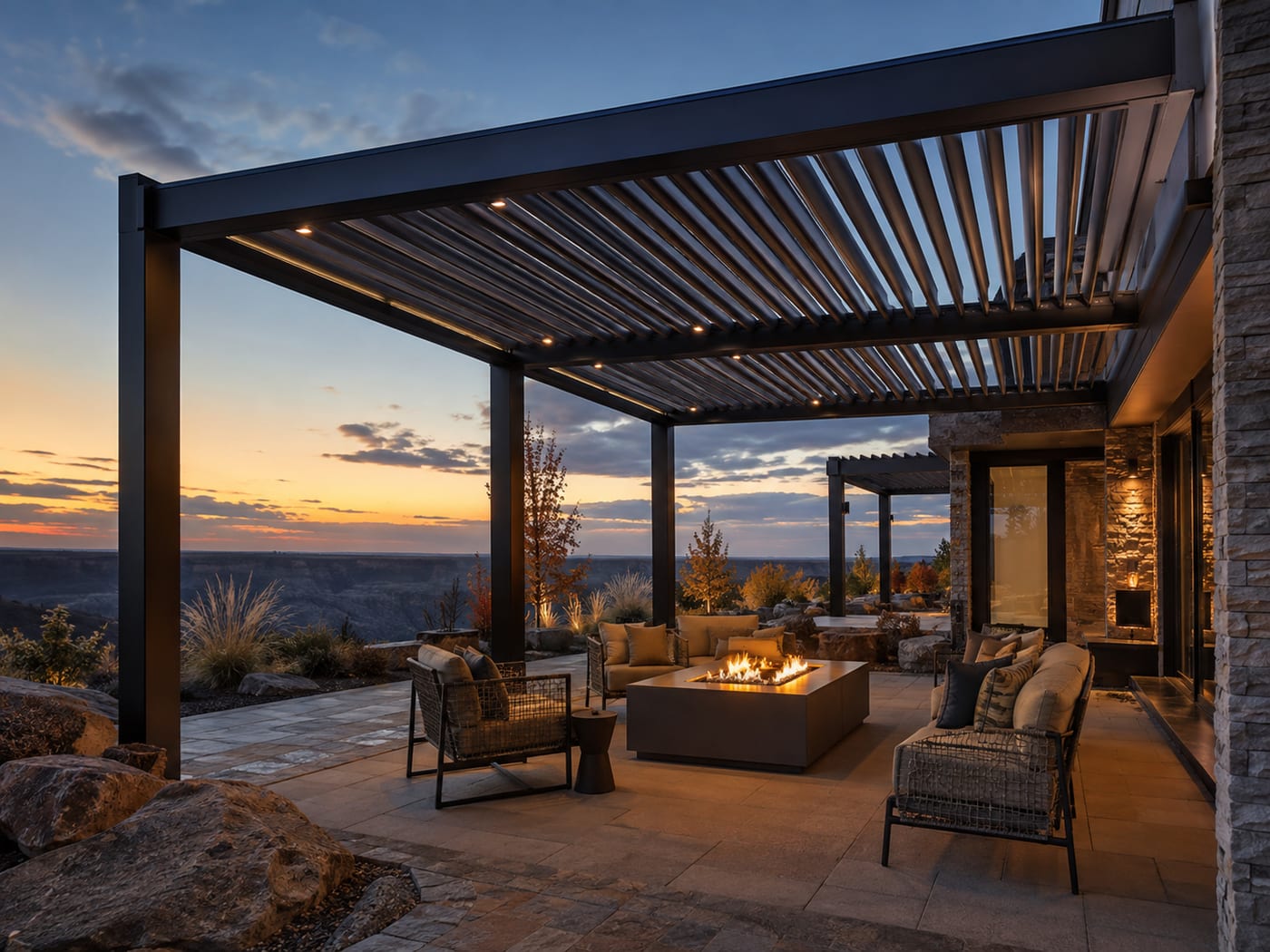
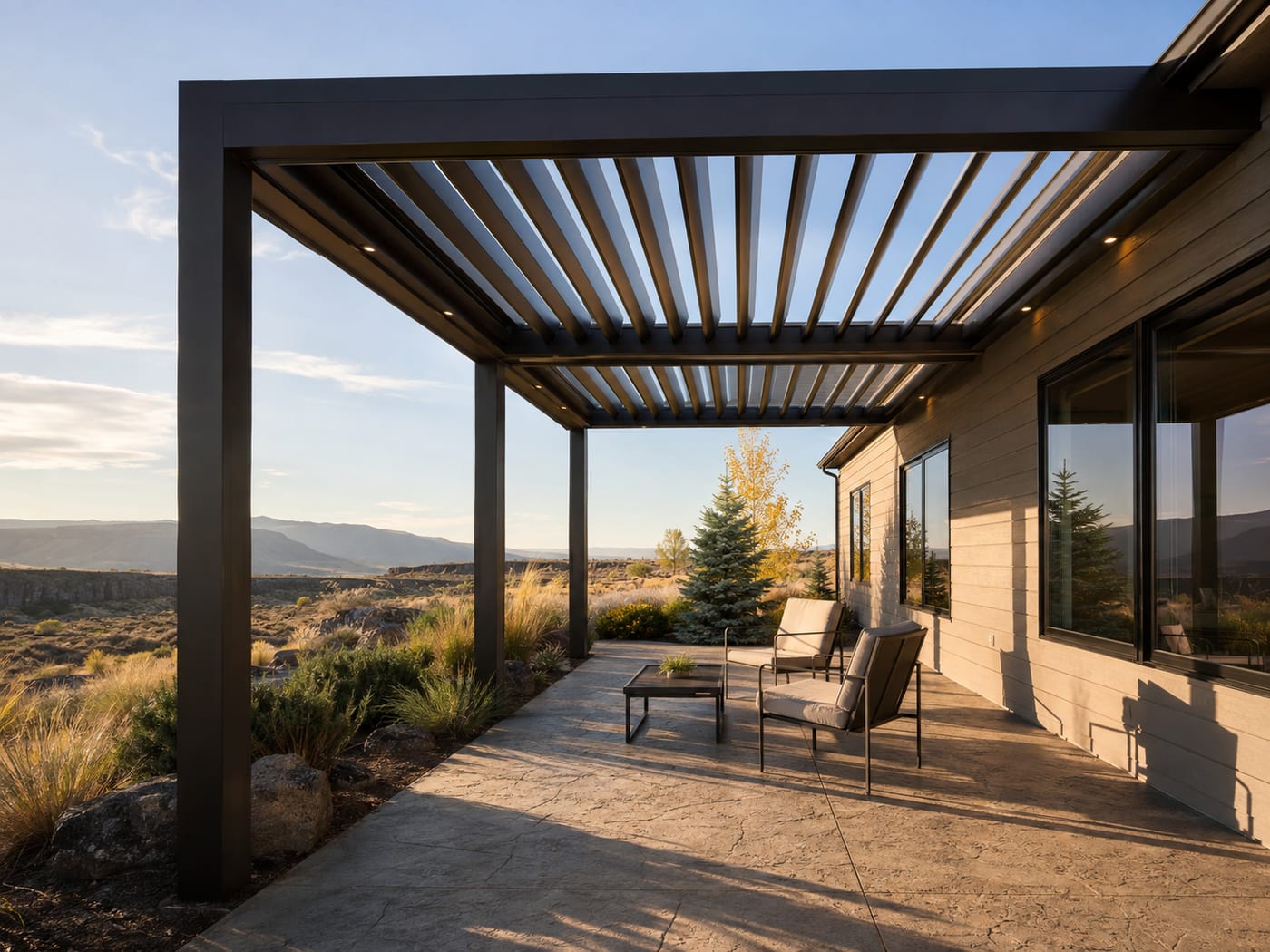
A louvered roof is a series of aluminum blades mounted on pivot pins inside a structural frame. Think horizontal window blinds, scaled up and engineered to shed water.
Every louver connects to a shared linkage bar along one edge of the frame. When the bar slides, all blades rotate together. That mechanical concept is old and reliable. What changed is how the bar gets moved.
On the Azenco R-Blade system we install, a central motor housed inside the beam drives the rotation of every louver in a bay through a linked arm, and the wiring runs concealed through the posts rather than surface-mounted afterward. Nothing about a properly installed system should look like hardware got bolted on later.
In practice:
- You send a signal. Remote handset, wall keypad, phone app, or an automatic sensor. The R-Blade works with Alexa, Google Home and Apple HomeKit.
- The controller interprets it. It manages direction, travel limits and stop positions.
- The motor drives the linkage. Azenco specifies IP55-sealed motors, meaning they're built for weather exposure rather than protected from it.
- All blades rotate together through a range of 0 to 160 degrees.
- Limit switches stop the travel so the system can't overdrive itself.
The three positions you'll actually use: fully open with blades near vertical for maximum airflow and light, tilted at roughly 30 to 40 degrees for filtered shade (where most owners leave it most of the season), and fully closed for weather.
Closed is where the engineering shows. The R-Blade uses dual-wall louvers that create a gapless seal and prevent backsplash, with rain running into an integrated gutter system that funnels water down through the support posts and away from the space below. Done properly you never see a downspout.
The features worth paying for
Not every option earns its keep. After enough service calls, here's the honest sort.
Weather sensors: this is the point. A rain sensor closes the roof automatically, in under 30 seconds on the R-Blade. A wind sensor opens the louvers in high wind to reduce uplift stress. If nobody's standing outside watching the sky, the roof still responds. Anywhere with canyon wind, which includes the Snake River rim, this matters more than the brochure suggests.
The freeze sensor: read this part twice. Azenco's temperature sensor signals the roof to open in freezing conditions to avoid damaging snow and ice buildup. Most homeowners assume closed is the winter setting. It generally isn't. A louvered roof sheds its load best when snow can fall through rather than accumulate on a sealed plane, which is also why published peak snow ratings are measured with the louvers open.
This is the single most important operating fact about these systems in an Idaho winter, and it's the one nobody explains at the point of sale.
Integrated LED lighting: worth it. Dimmable perimeter lighting on its own circuit is what turns the space into a room you use after dark.
Smart home integration: nice, not essential. Most owners use the handset the vast majority of the time.
One thing to check in writing: some dealers include rain and wind sensors as standard on a properly specified system, while the manufacturer presents the smart sensor array as an upgrade. Ask which you're getting. It's a real line item.
And a limitation worth stating plainly: this is a mechanical system with electronics outdoors. Durable, not maintenance free. Plan on clearing debris from the gutter channels twice a year, and expect the motor and actuator components to be serviceable items over the life of the structure rather than permanent ones.
What drives the cost in Idaho
Vague answers help nobody, so here are ours.
Entry-level louvered systems start around $9,999. Full motorized pergola projects generally land between $25,000 and $50,000 and up, depending on span, configuration and site conditions.
The spread is wide because these variables move the number more than people expect:
Span and square footage. Longer louver spans need heavier blade profiles and more support. Cost per square foot climbs faster than the area does.
Attached versus freestanding. Freestanding needs four posts and independent footings. Attached ties into your home's structure and demands careful flashing at the connection.
Foundation work. Frost depth in both the City of Twin Falls and Twin Falls County is 24 inches, so footings have to reach below that. Excavation and concrete are real line items, and rock on the canyon rim can change the number.
Electrical. A dedicated circuit from the panel, plus lighting, heat or fans. This is also what makes the permit non-optional, which we'll come back to.
Structural engineering. A pergola in Ketchum is engineered differently than one in Filer. That work shows up on the invoice, and it should.
Permits and inspections.
If you're comparing bids, insist every quote specify blade material and gauge, motor manufacturer, warranty terms broken out by structure, motor and finish separately, permit responsibility, and full electrical scope. Two quotes that look $8,000 apart are frequently describing different products.
What this means in the Magic Valley specifically
Snow load here is documented, and the numbers differ depending on which side of the city line you're on.
Inside Twin Falls city limits, the published residential design criteria set a ground snow load of 15 psf with a minimum uniformly distributed design roof load of 25 psf by local ordinance. In unincorporated Twin Falls County, ground snow load is 30 psf, double the city figure. Both are at 115 mph design wind and 24-inch frost depth.
That gap matters when you're comparing products. A system rated at the city's 25 psf minimum has no margin at all, and sits below what the county asks of the ground load. This is exactly the kind of detail that separates a real quote from a brochure number, and it's worth asking any contractor to show you the engineering for your address rather than the maximum rating for the product line.
Up the valley in Hailey and Sun Valley, elevation, drifting and freeze-thaw cycling push the specification further: heavier gauge, deeper footings, and wind sensing that stops being optional.
Permits: the short version
A motorized pergola in Twin Falls needs a permit. Not usually, not probably. The city requires a permit for all electrical, plumbing, mechanical and gas work, with no size threshold and no exemption, and the city inspects those trades itself. A motor is electrical, which settles it before you even reach the question of square footage or attachment.
Outside city limits, the structure goes through Twin Falls County at (208) 734-9490 while electrical routes to the state through the Idaho Division of Occupational and Professional Licenses. Holding a county building permit does not remove the need for the state one.
We cover this in detail in our guide to patio cover permits in Twin Falls.
Is it worth it?
Honest answer: if you use your outdoor space a dozen times a year, a shade sail or a manual pergola will serve you at a fraction of the cost. These systems earn their price when they convert a patio you avoid into a room you occupy daily from April through October.
The homeowners happiest with the investment tend to share traits. They entertain outside regularly. Their patio faces west or south. They own outdoor furniture worth protecting. And they'd rather not think about the weather.
We'd rather tell you a louvered roof is wrong for your property than sell you one you regret.
Get a real number instead of a range
A free on-site evaluation covers your sun exposure, your span, your site conditions, and what your specific address requires. You'll get an itemized quote, not an estimate.
Book a Free Design Consultation or call (208) 731-1729
Frequently asked questions
Should I close the louvers when it snows? Usually not, and this surprises people. Azenco's temperature sensor is designed to open the roof in freezing conditions specifically to prevent snow and ice buildup, and peak snow ratings for louvered systems are generally measured in the open position. Follow your system's guidance and your installer's instructions rather than assuming a closed roof is the protected one.
Can motorized louvers handle Idaho snow? Yes, when engineered for your jurisdiction. The requirement differs meaningfully across the state and even across the Twin Falls city line: 25 psf minimum design roof load inside the city, 30 psf ground snow load in the county, and considerably more at elevation. Ask for the engineering calculated for your address rather than the product's maximum published rating, since those are different numbers.
What happens during a power outage? Louvers hold their last position when power is lost, so a roof that was closed before the storm stays closed. Confirm what manual override or backup your specific system includes before you buy.
Do I need a building permit? In Twin Falls, yes. The city requires a permit for all electrical work with no size exemption, and a motorized system is electrical by definition. Outside city limits the structure and the electrical are permitted separately, through the county and the state respectively. We manage that process on every installation.
How much maintenance is involved? Modest but not zero. Rinse the blades a couple of times a year, clear leaves and debris from the integrated gutter channels, and keep insects from nesting near the motor housing. No painting, staining or sealing. The mechanical and electronic components are serviceable items over the structure's life.
How long does installation take? On-site work is usually the short part. Material lead times and permitting are what set the real schedule, and both vary by season and configuration. Ask for a written timeline that separates permitting, material delivery and installation, so you can see which stage is actually driving your date.
What's the difference between a $10,000 and a $35,000 louvered pergola? Span, blade profile and gauge, whether the louvers are single or dual wall, motor quality and sealing, whether gutters are integrated or surface-mounted, sensor package, engineering, and the snow and wind rating the structure is actually calculated to. Those differences are invisible in a photograph and obvious in a Twin Falls February.
This article is general guidance for the Twin Falls area, not a code ruling. Design criteria and permit requirements differ between the City of Twin Falls and Twin Falls County. Confirm specifics for your property with City Building Safety at (208) 735-7238 or Twin Falls County Community Development Services at (208) 734-9490 before you build.