Should You Wait Until Spring for a Patio Cover?
Waiting until spring to build is often right. Waiting until spring to start is what costs you the summer. What cold actually stops, what it does not, and why winter site visits tell you more.
TL;DR
- The structure does not care about winter. The footings do. Aluminum covers install in cold weather without trouble. Concrete is the constraint.
- The concrete rules are specific. Industry standards treat it as cold weather concreting once the average daily temperature sits below 40°F for more than three days running, with minimum placement temperatures of 40°F to 55°F depending on how thick the pour is.
- You cannot pour onto frozen ground. It freezes the bottom of the pour, and when the subgrade thaws it heaves and cracks what you just placed.
- The front half of a patio project is paperwork, not construction. Design, engineering, permits and material lead times all happen fine in January.
- Spring is a queue. Everyone calls in April, and the people who called in December are already scheduled.
- The right move in late October is to start the process, not the pour.
Every year around now, homeowners ask us some version of the same question. It is cold, the season is over, should they just call back in the spring?
The honest answer is that waiting until spring to build is often correct. Waiting until spring to start is usually a mistake, and it is the reason some people spend their entire summer waiting while their neighbors are already using the space.
Here is what winter actually prevents and what it does not.
What winter genuinely stops: the concrete
Footings here go below a frost depth of 24 inches, in both the City of Twin Falls and Twin Falls County. That means concrete on every project, and concrete is where cold weather stops being a scheduling preference and becomes a physics problem.
Industry guidance defines cold weather concreting as a stretch of more than three consecutive days where the average daily air temperature is below 40°F and the temperature stays below 50°F for more than half of any 24-hour period. Once you are in that window, concrete has to be placed warmer than you would expect: roughly 55°F for sections under 12 inches, 50°F for 12 to 36 inches, 45°F for 36 to 72 inches, and 40°F for anything thicker. Thinner sections need to start warmer, because they lose heat faster.
The subgrade matters as much as the air. The ground you are pouring onto has to be above freezing. Place concrete on frozen ground and the cold pulls heat out of the bottom of the pour while you are protecting the top. Worse, when that frozen subgrade thaws, it heaves and then settles, and it can crack the concrete even if the surface cured perfectly.
Then there is the protection period. Concrete has to be held above freezing until it reaches about 500 psi, which is roughly the point where the remaining mix water will no longer cause freeze damage. That is typically at least 48 hours and can run up to four days depending on temperature and whether an accelerator was used. Protection then has to come off gradually rather than all at once.
All of that is doable. Insulating blankets, heated enclosures, thawing the ground before placement, and mix adjustments are standard tools. But it adds cost, it adds schedule risk, and in a county whose published design temperature is zero degrees Fahrenheit and whose weathering probability for concrete is rated Severe, there are stretches where the right call is simply to wait for a window.
What winter does not stop
Almost everything else.
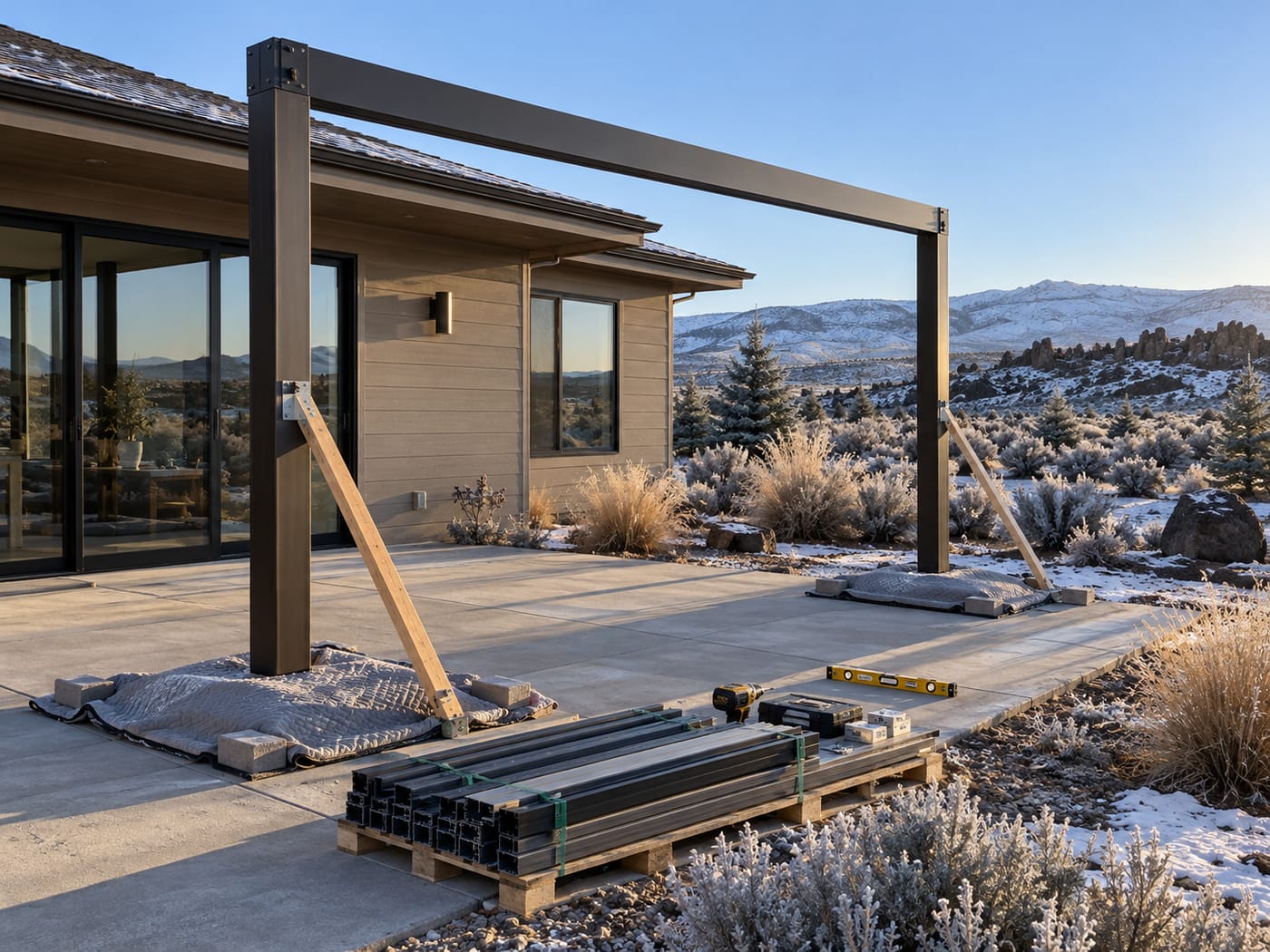
The structure itself. Aluminum is unaffected by temperature and humidity. Once footings are in and cured, an aluminum cover goes up in a matter of days regardless of the month.
Design. Walking the space, measuring sun angles, deciding attached or freestanding, settling span and post placement. None of that requires warm weather, and the January version of that conversation is usually better than the April version because nobody is rushing.
Engineering. Calculating your design load for your span, your exposure category and your address is desk work.
Permits. This is the big one, and it is the reason to start now. The City of Twin Falls publishes a two-week target to first plan review for residential projects, and that is to first review, not to approval. Corrections add another round. Outside city limits, the county has its own process, and since September 2025 charges a plan review fee equal to 35 percent of the building valuation fee, due when you submit. Electrical in the county routes to the state separately.
Our full breakdown of which office handles what is in our guide to patio cover permits in Twin Falls.
Material lead times. Engineered systems are manufactured to your dimensions, not pulled off a shelf. That lead time runs in parallel with permitting if you start early and in series if you start late. Ask any contractor you talk to for the current figure in writing.
Winter shows you things summer hides
There is an argument for a cold-weather site visit that has nothing to do with scheduling.
The sun is in the wrong place in July. When you stand on your patio in August, the sun is high and the problem looks like overhead heat. The low winter sun comes in sideways, which is a different problem and sometimes a different solution. If you want a space you can use in March and October, the shoulder-season sun angle is the one worth designing around, and you can only see it now.
Snow tells you where water goes. Watch your roof shed after a storm and you learn exactly where an attached cover would sit in the line of fire. You also see where meltwater runs across the patio, where it pools, and where it refreezes into the patch nobody wants to walk on. That information changes post placement and drainage design, and it is invisible in June. We cover why that matters structurally in our guide to attached versus freestanding covers.
Wind is honest in winter. The prevailing direction on an exposed lot is easier to read when there are no leaves on anything and you are standing there in it.
A contractor who sees your space in February is designing with better information than one who sees it in June.
Spring is a queue, and you choose your place in it now
Here is the part nobody mentions.
Patio work is seasonal. Every contractor in the Magic Valley gets the same wave of calls starting when the weather breaks, and installation slots fill in the order people committed, not the order they called. A homeowner who signs in December has design done, permits approved and material on the way before the first warm week arrives. A homeowner who calls in April starts the two-week plan review clock in April.
That is frequently the difference between using your patio in June and using it in August.
There is a secondary advantage worth knowing: in the city, inspection requests submitted through the portal by 7:00 AM are scheduled the same day, and concrete and foundation inspections receive scheduling priority. The system is set up to keep footings moving. The bottleneck is almost never the inspector. It is the eleven weeks of design, review and manufacturing that happen before anyone calls one.
What a realistic winter-to-spring timeline looks like
Not a promise, since every project differs, but the shape of it:
Now through December. Site visit, design, build-path decision, fixed quote. Engineering if the project needs it.
December through February. Permit submittal and plan review, including any correction rounds. HOA approval if your subdivision requires it, which is its own timeline and worth starting early. Material ordered.
Late winter. Material arrives. Crew scheduled against the first workable ground window.
First window the ground allows. Footings poured, cured and inspected.
Days later. The structure goes up.
The paperwork is the long pole. The building is fast.
When waiting really is the right call
We would rather say this than oversell a winter start.
If you are not sure what you want yet. Design churn costs more than a season does. A project you rushed into in December and want to change in February is worse than one you thought about properly.
If the budget is not ready. Financing a project on a deadline is a bad reason to commit. Our range for motorized pergolas runs $25,000 to $50,000 and up, with a manual louvered line starting near $9,999, and the cost breakdown is worth reading before you decide.
If the scope includes significant ground work. A new slab, major regrading or drainage work is more weather-dependent than a cover on existing concrete, and that can genuinely push a project.
What is almost never the right call is doing nothing for four months and then expecting to be first in line.
Start the paperwork now, build when the ground allows
A free design consultation in November costs you an hour and puts you at the front of the spring schedule. We will walk your space, tell you which build path fits, and give you a written timeline that separates design, permitting, material lead time and installation, so you can see what is actually driving your date.
Book a Free Design Consultation or call (208) 731-1729
Frequently asked questions
Can you install a patio cover in winter in Idaho? The cover itself, yes. Aluminum is unaffected by cold and the structure goes up in days. The limiting factor is the footings, since concrete needs the subgrade above freezing and has to be protected while it cures. Cold weather pours are done routinely with blankets, heated enclosures and mix adjustments, but they add cost and schedule risk, so a short wait for a workable window is often the better call.
Why can't you pour concrete on frozen ground? Because the frozen subgrade pulls heat out of the bottom of the pour, and because it heaves as it thaws and then settles again. Either effect can crack concrete that looked fine on the surface. The ground has to be thawed and above freezing before placement.
How long does the whole process take from first call to finished cover? Design and quoting are quick. Permitting in the city targets two weeks to first plan review, with corrections adding time, and the county runs its own process. Material for an engineered system is manufactured to your dimensions, so lead time varies. Installation itself is short. Ask for a written timeline that separates those stages rather than a single number.
Is it cheaper to build in the off season? Not reliably, and anyone promising a deep winter discount is worth questioning. The real off-season advantage is scheduling rather than price. You get more of a contractor's attention in January, and you get an earlier installation slot in spring.
Should I wait for spring to get quotes? No. Quoting in winter costs nothing and gives you time to compare properly instead of deciding under pressure. It also means that if you do move forward, permitting and manufacturing happen during months when you were not using the patio anyway.
This article is general guidance for the Twin Falls area. Concrete placement and curing requirements follow industry standards and your contractor's judgment on site conditions, and permit timelines vary with workload and project complexity. Confirm current requirements with City Building Safety at (208) 735-7238 or Twin Falls County Community Development Services at (208) 734-9490.