
Motorized vs. Manual Louvered Pergolas: Idaho Guide
A manual louvered roof starts near $9,999 and a motorized one runs far higher. What actually differs, why sizing and sensors matter more than price, and how Twin Falls loads affect the choice.
TL;DR
- Manual systems start around $9,999. Motorized systems generally run $25,000 to $50,000 and up. That gap is the real question behind most of these conversations.
- A manual louvered roof does the same core job. Aluminum blades, adjustable angle, integrated gutters, no power required.
- Where they differ: rotation range, sizing flexibility, and automation. Manual systems typically rotate up to 90 degrees and come in fixed modular sizes. Motorized systems rotate through a wider range and are custom-built to your space.
- The biggest practical difference is who reacts to weather. A motorized roof has rain, wind and freeze sensors. On a manual roof, you are the sensor.
- No power means no electrical permit trigger. In Twin Falls, any electrical work requires a permit with no size exemption. A hand-cranked system with no wiring avoids that specific trigger, though the structure itself may still need a permit.
- Check load ratings against your address, not the brochure. Published maximums describe standard configurations. Twin Falls city requires a 25 psf minimum design roof load, the county's ground snow load is 30 psf, and both use 115 mph design wind.
Most people arrive at this question through price. A manual louvered pergola starts around $9,999. A motorized system typically runs $25,000 to $50,000 and up. That's a meaningful gap, and the honest answer to "is the motor worth it" is that it depends on things nobody asks about at the showroom.
Here's how we actually talk it through with homeowners.
What's the same
More than you'd expect. Both systems are extruded aluminum with powder-coat finishes. Both use adjustable blades that pivot together to control sun and shade. Both close to shed rain, and both route water through an integrated gutter system rather than dripping through the roof. Both are non-combustible, which matters if you're planning a fire feature underneath.
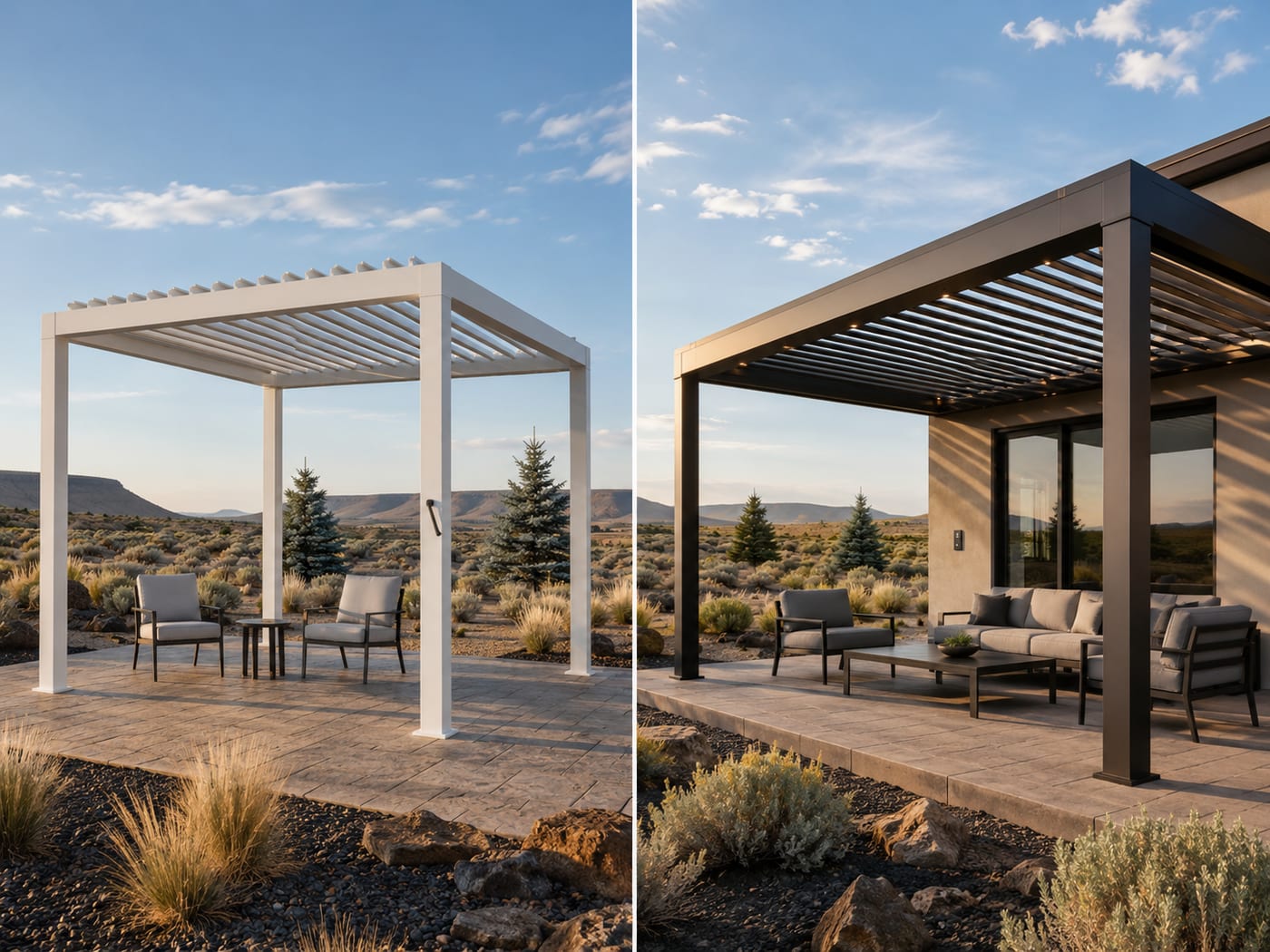
If your mental model is "the cheap one is the flimsy one," that's not the distinction. On Azenco's line, the manual K-BANA and the motorized R-BLADE share the same aluminum construction and powder-coating process. The difference isn't material quality. It's control, sizing, and how the roof responds when you're not standing under it.
What's different
How the louvers move. A manual system uses a hand crank to tilt the blades. No motor, no wiring, no electronics. A motorized system uses a concealed motor driving a linkage, operated by remote, wall switch, phone app, or automatic sensor.
Rotation range. Manual louvered roofs generally rotate up to 90 degrees, giving you fully open or fully closed and the positions in between. Motorized systems on the R-BLADE move through a range of 0 to 160 degrees, which allows blade positions past vertical for different light and airflow behavior.
Sizing. This is the constraint people underestimate. Manual systems come in fixed standard sizes, typically 10 by 10 and 12 by 12 feet, which combine modularly side by side, back to back, or into L and U shapes. That's genuinely flexible for open yards and poolside areas. It's less accommodating when you need to cover an odd-shaped patio or tie cleanly into an existing roofline. Motorized systems are custom-engineered to the space, including attached installations that integrate with the house.
Finish options. Manual systems typically offer two standard colors. Motorized systems are available in hundreds.
Power and placement. A manual pergola needs no electricity at all, which means it can go anywhere on the property, including spots where running a circuit would be expensive or impractical. A motorized system requires a dedicated circuit from the panel.
Installation. A modular manual unit can go up in hours. A custom motorized structure is a full build with footings, electrical and inspections.
The difference that actually matters in Idaho
Automation sounds like a luxury feature. In this climate it's closer to a functional one.
A motorized system with a sensor package responds on its own. Rain detection closes the roof. A wind sensor opens the louvers to reduce uplift stress. And Azenco's temperature sensor opens the roof in freezing conditions specifically to prevent snow and ice buildup, since a louvered roof sheds its load best when snow can fall through rather than accumulate on a sealed plane.
On a manual system, all of that is your job. You crank it.
For most of the year that's fine. Nobody minds adjusting a roof on a July afternoon. The question is February, when a storm arrives while you're at work, or a heavy wet snow starts at 2am, or you're away for a week in January. A manual roof holds whatever position you left it in.
That's not an argument against manual systems. Plenty of Magic Valley homeowners are around, pay attention to the forecast, and would rather put the $15,000 difference into a fire feature or an outdoor kitchen. It's an argument for being honest with yourself about how you actually live.
Read the load ratings against your address
This is where we'd push back on how these products get sold generally, including ours.
Published ratings are maximums under standard configurations. The Azenco K-BANA is listed at up to 25 psf snow load and up to 105 mph wind, though you'll find different wind figures across different dealer sites. The R-BLADE is published considerably higher, up to 100 psf snow and 190 mph wind, and it carries a Miami-Dade NOA.
Now compare that to what Twin Falls asks. Inside city limits, the published residential design criteria set a ground snow load of 15 psf with a minimum uniformly distributed design roof load of 25 psf by local ordinance. In unincorporated Twin Falls County, ground snow load is 30 psf. Both jurisdictions use a 115 mph design wind speed, and frost depth is 24 inches.
Those numbers sit close together, and that's the point. Product maximums and code design criteria are not measured the same way, so you cannot line them up in a column and declare a winner. What you can do is refuse to accept a brochure figure as an answer. Ask for engineering calculated for your span, your exposure, and your address.
A manual system is a genuinely good fit for plenty of properties here, particularly inside city limits with sheltered exposure and modest spans. It deserves a closer look for county properties, longer spans, or exposed sites on the rim. Either way, the number that matters is the one an engineer produces, not the one on the product page.
Permits: one real advantage for manual
There's a wrinkle here worth knowing.
Inside Twin Falls city limits, a permit is required for all electrical, plumbing, mechanical and gas work, with no size threshold and no exceptions. A motorized pergola is electrical by definition, which settles the permit question before you even discuss square footage.
A hand-cranked system with no wiring doesn't trip that particular trigger. That is not the same as saying it needs no permit. Attached structures are additions, detached accessory structures over 200 square feet require permits, and the city's zoning use permit rules apply separately. But it removes one automatic trigger from the equation, and for a freestanding unit in an open yard, it can simplify things.
Outside city limits the structure goes through Twin Falls County, and any electrical routes to the state rather than the county. We cover the full breakdown in our guide to patio cover permits in Twin Falls.
How we'd help you decide
The short version of the conversation we have on site:
Manual is likely right if you're covering an open area that suits a standard footprint, you don't need to tie into the house, you're around regularly and comfortable adjusting a roof yourself, you want to get something built this season, or the budget difference is better spent on a fire feature or seating.
Motorized is likely right if your patio is an odd shape or needs to attach to the house, you travel or are away during weekdays, you want the roof to handle weather without you, you're planning integrated lighting, heat or screens, or your site is exposed enough that automatic wind and freeze response has real value.
A custom build may be right if neither standard system fits the geometry of your space, which happens more often than the catalogs suggest.
Let's figure out which one fits your yard
A free design consultation covers your space, your exposure, your budget, and an honest recommendation. Sometimes that recommendation is the less expensive one.
Book a Free Design Consultation or call (208) 731-1729
Frequently asked questions
Is a manual louvered pergola worth it, or should I save for motorized? It depends on your patio and your habits more than your budget. If a standard modular footprint suits your space and you're around to adjust the roof, a manual system does the core job well at a fraction of the cost. If your patio is oddly shaped, needs to attach to the house, or sits empty on weekdays, the motor is doing real work rather than adding convenience.
How much more does motorized cost? Manual systems start around $9,999. Motorized projects generally run $25,000 to $50,000 and up depending on span, configuration and site conditions. The gap comes from custom engineering, larger and more complex structures, the motor and sensor package, electrical work, and permits.
Can I add a motor to a manual pergola later? Generally no. The two systems are engineered differently from the frame up, and the motorized version isn't a manual unit with a motor attached. Decide up front rather than planning to upgrade.
Do manual louvered pergolas handle snow? They're built for snow and rain and drain through integrated gutters, but published load ratings vary by product and configuration. Given that Twin Falls city requires a 25 psf minimum design roof load and the county's ground snow load is 30 psf, this is exactly the number to have engineered for your address rather than taken from a spec sheet.
Do I need a permit for a manual pergola? Possibly, and for different reasons than a motorized one. A hand-cranked system with no wiring avoids the city's automatic electrical permit trigger, but attachment to the house, size over 200 square feet, and zoning requirements can each require a permit on their own. Outside city limits the county has its own rules.
Can I put lighting on a manual pergola? Yes, and there are solar lighting options that keep the structure entirely off-grid. Adding hardwired lighting brings you back into permit territory in the city, since any electrical work requires one.
How long does installation take? A modular manual unit can be installed in hours once the site is prepared. A custom motorized structure is a full build involving footings, curing time, electrical and inspections. Material lead times and permitting usually set the real schedule for either one.
This article is general guidance for the Twin Falls area, not a code ruling. Product ratings describe standard configurations and are not a substitute for site-specific engineering. Confirm requirements for your property with City Building Safety at (208) 735-7238 or Twin Falls County Community Development Services at (208) 734-9490 before you build.