Can You Put a Fire Feature Under a Pergola?
Yes, usually, if the fuel is gas and the roof is aluminum. Here are the real clearance numbers, why the 10-foot rule you'll find online is a misread, and who issues the gas permit at your address.
TL;DR
- Usually yes, if it's gas and the roof is aluminum. Four things have to be true: non-combustible overhead, adequate ventilation, enough vertical clearance, and the right fuel.
- The "10 feet of clearance" rule you'll find online is a misread. It comes from a fire code section about open burning distances measured horizontally, not from anything about roofs overhead.
- Your appliance's listing is what actually governs. Published manufacturer minimums for typical residential gas units generally land around 7 to 8 feet of vertical clearance to a non-combustible surface, with BTU output as the deciding variable.
- Most pergolas already clear that. Residential installations commonly give 8 to 10 feet from the fire surface to the underside of the louvers.
- Wood burning is the wrong choice under any cover. Sparks, smoke and soot.
- Closed louvers change the ventilation math. A roof that seals against rain is not the same environment as an open one, and gas appliances need airflow.
- Gas work needs a permit, and where you get it depends on your address. Inside Twin Falls city limits the city handles it. Outside city limits it goes through the state.
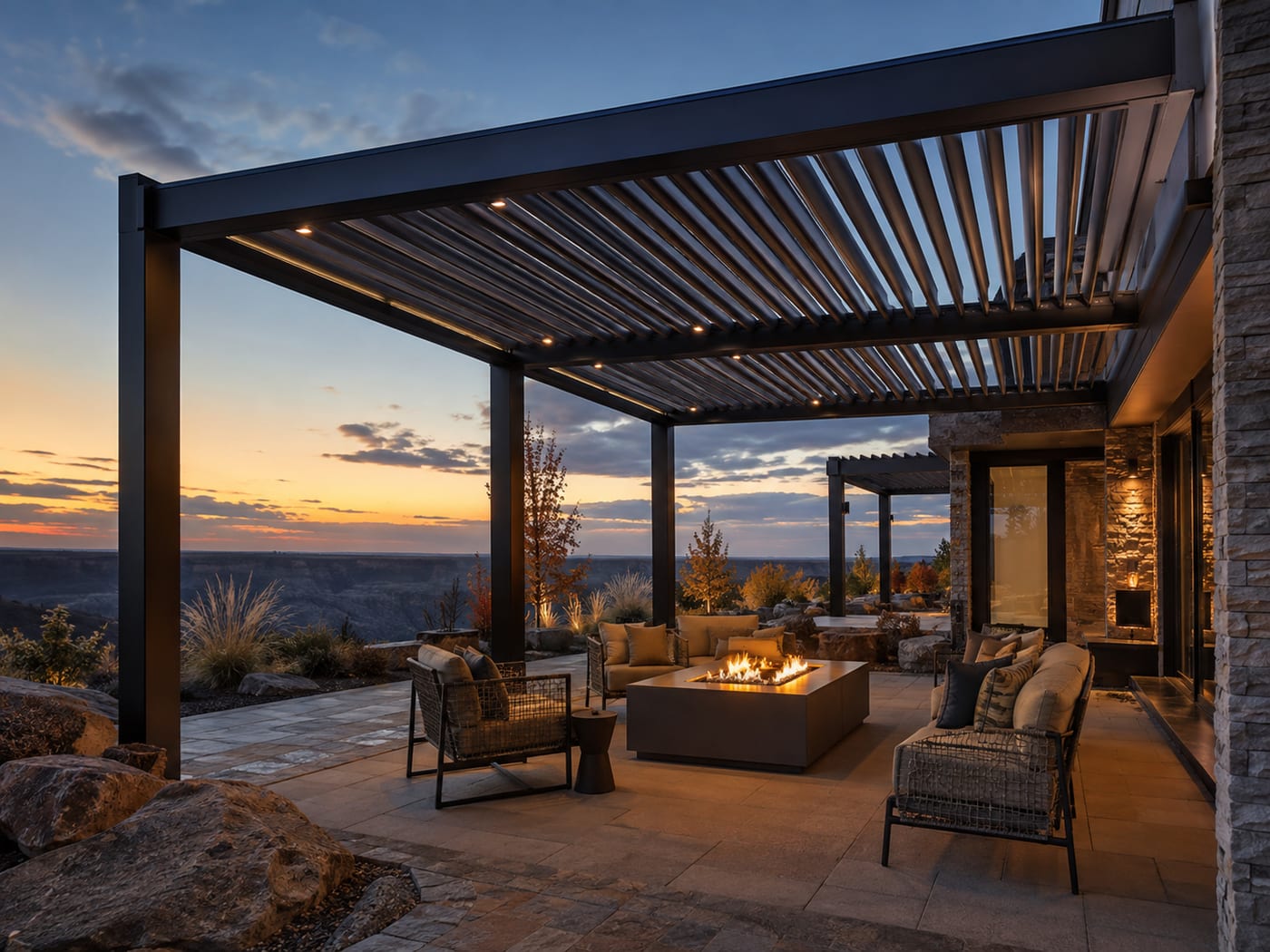
A gas fire feature glowing under a covered patio on a cold October evening is the single most compelling thing you can build in an Idaho backyard. It's also the combination that generates the most nervous questions, and the answers online are a mess.
Here's what actually applies, and what a Magic Valley homeowner should ask before signing anything.
The short answer
Yes, in most cases, provided four conditions are met: the overhead material is non-combustible, there's adequate ventilation, there's sufficient vertical clearance between the fire surface and the structure above, and the fuel is gas rather than wood.
An aluminum louvered pergola satisfies the first condition by design. A wood pergola does not. That distinction matters more than any single measurement.
The 10-foot rule you'll read online is wrong
Search this question and you'll repeatedly find that a fire pit requires 10 feet of vertical clearance under a pergola, cited to International Fire Code section 307.4 and NFPA 211. That citation does not say what people think it says.
IFC 307.4 governs open burning, recreational fires and portable outdoor fireplaces, and the distances it sets are horizontal separation from structures, not clearance beneath a roof. The code states that recreational fires shall not be conducted within 25 feet of a structure or combustible material, and that portable outdoor fireplaces shall be used per the manufacturer's instructions and shall not be operated within 15 feet of a structure or combustible material. That second rule carries an explicit exception for portable outdoor fireplaces used at one- and two-family dwellings, which is to say most homes.
NFPA 211 covers chimneys, fireplaces, vents and solid fuel-burning appliances. A listed gas fire table is not a solid fuel appliance.
So the widely repeated figure is a horizontal open-burning number applied to a vertical question about a manufactured appliance. It's the kind of error that sounds authoritative and sends people to the wrong conclusion in both directions: some homeowners give up on a setup that would have been fine, and others assume the number is a ceiling they can safely ignore.
What actually governs: the appliance's listing
A permanently installed gas fire feature is a listed appliance. Its own instructions and listing set the required clearances, and those are the numbers a building official and a fire marshal will look at.
Published minimums from manufacturers cluster more tightly than the blogs suggest, and BTU output is the deciding variable. A few examples of what different makers publish:
- HPC Fire specifies, for a standard burner of 200,000 BTU or less, 36 inches horizontally from the edge of the burner pan to anything combustible and 84 inches from the top of the fire pit enclosure to the ceiling, along with two open walls for ventilation. Between 200,000 and 400,000 BTU, an overhead structure is acceptable if the space above the burner pan is 50 percent open and non-combustible.
- DreamCast sets a minimum of 84 inches of overhead clearance to a non-combustible structure, more where combustible materials are involved, with ventilation following ANSI Z21.97 and CSA 2.41 guidance.
- Celestial Fire Glass puts the threshold at 96 inches for units under 195,000 BTU, says anything above that belongs in a fully open area, and advises against vinyl overhead because it warps under heat even at that distance.
The pattern is roughly 7 to 8 feet for a typical residential gas unit under a non-combustible roof. These are examples, not a standard. Yours will have its own numbers, and those numbers are the ones that count.
The good news for most people: residential pergola installations commonly provide 8 to 10 feet from the fire surface to the underside of the louvers, which clears typical gas requirements without modification.
Ventilation, and the thing nobody mentions about closed louvers
Clearance is the easy part. Ventilation is where covered fire installations actually get complicated.
Gas appliances produce combustion byproducts, and every set of manufacturer guidance assumes those products can rise and escape. HPC's requirement for two open walls exists for exactly that reason. A louvered pergola with open sides and open louvers is close to an ideal environment: heat and combustion products rise straight through.
But a motorized louvered roof has two states, and the marketing usually only celebrates one of them. The closed position is the selling point, the one that keeps rain off your dinner. It's also the position where the roof stops behaving like an open structure. Add drop screens or side panels on top of that and you've moved further still toward an enclosed space.
This does not mean you can't have both. It means the fire feature and the roof need to be designed together, with the closed-louver condition considered rather than assumed away, and with clear guidance on how to operate the two together. A builder who sells you a sealed roof and a fire table without ever raising this question hasn't thought it through.
Gas or wood
For a covered space, gas. It isn't close.
Wood-burning features throw sparks and embers, produce unpredictable flame height, and generate smoke and soot that accumulates on the powder-coated finish overhead. Gas gives controlled, adjustable output with no ember production, which removes the primary ignition risk for the structure above.
There's a local dimension too. Outdoor open burning is subject to restriction here. Idaho DEQ prohibited all outdoor open burning across the Magic Valley starting in late July 2026 under the state's air pollution rules, and active burn permits inside the City of Twin Falls were suspended for the duration. Wood fires are exposed to that kind of interruption in a way a permanently plumbed appliance generally is not, though how a specific restriction applies to a specific appliance is a question for the fire marshal rather than a contractor.
Worth knowing separately: Twin Falls does not require a burn permit for cooking, small recreational fires, or an outdoor fireplace. Burn permits are required for burning materials grown on your property.
The permit question, and why your address decides it
This is where Magic Valley homeowners get caught, because the answer is different on either side of the city line.
Inside Twin Falls city limits. The city requires a permit for all electrical, plumbing, mechanical and gas work, with no size threshold and no exceptions. The city has assumed local jurisdiction for those trades and inspects them itself. Building Safety is at (208) 735-7238. For clearance and fire code questions, the Fire Marshal's office is the authority, currently Gabriel Hammett, at (208) 735-7232, with a separate fire inspection line at (208) 735-7338.
Outside city limits. The gas permit leaves the county entirely and goes to the state. Twin Falls County handles the structure through Community Development Services at (208) 734-9490, but electrical, plumbing and gas route through the Idaho Division of Occupational and Professional Licenses. DOPL's building code and permits line is (208) 334-3233, with permit and inspection support at (208) 334-3950 and inspection requests at (208) 332-4700.
Fire code is a third layer out there. Unincorporated Twin Falls County is covered by a patchwork of rural districts, including Rock Creek Rural Fire Protection District, Salmon Tract Rural Fire District, Buhl Fire Department and Castleford Fire District. Which one covers your address depends on where you sit.
So a county fire feature can involve three separate authorities: the county for the structure, the state for the gas, and a local rural district for fire code. DOPL specifically notes that holding a building permit from a city or county does not necessarily remove the need for separate state permits, which is exactly the assumption that trips people up.
Who pulls the permit
Your licensed contractor, and on the gas side that isn't just good practice.
DOPL states that contractors are required to obtain permits in their own name and may not legally perform work under a property owner's permit. Homeowner permits exist only for homeowners doing the work themselves on their own residence. So a contractor asking you to pull the gas permit is asking for something outside how the state's system is designed to work.
Skipping it has a price. When work gets completed without a required permit, DOPL issues an Enforcement Permit at double the original fee.
We handle permitting, gas lines, footings, electrical and inspections in-house on every project we build, in the city and in the county.
Let's design it properly
A fire feature and a cover are two projects that need to be planned as one. A free design consultation covers your space, your budget, the clearances your specific setup needs, and exactly what your address requires.
Book a Free Design Consultation or call (208) 731-1729
Frequently asked questions
How much clearance does a gas fire pit need under a pergola? Published manufacturer minimums for typical residential gas units generally fall around 84 to 96 inches, roughly 7 to 8 feet, measured to a non-combustible surface above. BTU output is the deciding factor, and higher-output units require more clearance or a partially open roof. Your appliance's own listing sets the requirement, so check it and confirm with the fire marshal rather than relying on a general figure.
Is it 10 feet, like everyone online says? That number is usually cited to IFC 307.4, which is about open burning and sets horizontal distances from structures, not vertical clearance under a roof. It's a misapplied citation. The governing document for a listed gas appliance is its own listing.
Can I put a fire pit under a wood pergola? Much harder, and generally not advisable. Wood is combustible, which means greater required clearances and ongoing risk from heat exposure and drying over time. Vinyl is worse, since it can warp from radiant heat even at otherwise adequate distances. An aluminum structure is non-combustible, which is why it's the practical answer for this combination.
Can I use a wood-burning fire pit under a cover? We don't recommend it. Sparks and embers, unpredictable flame height, and smoke that leaves soot on the finish overhead. Gas is the right fuel for a covered space.
Can I close the louvers while the fire is running? Ask before you assume. Closing the roof changes a well-ventilated space into a more enclosed one, and gas appliances depend on combustion products being able to rise and escape. This should be designed and explained up front, not discovered later.
Do I need a permit for a gas fire pit in Twin Falls? Inside city limits, yes. The city requires a permit for all gas work with no size exemption. Outside city limits, the structure goes through Twin Falls County while the gas permit goes through the state at DOPL. Portable propane units that simply connect to a tank are a different situation from a permanently plumbed gas line, so confirm which one you're actually installing.
Who do I call about clearances specifically? Inside the city, the Twin Falls Fire Marshal's office at (208) 735-7232. Outside city limits, your local rural fire district. Building and gas permits are handled separately from fire code questions.
Does a fire feature let me use the patio later into the year? That's the main reason people build them here. Combined with an overhead cover and side screens, a fire feature meaningfully extends comfortable evenings into the shoulder seasons, which in the Magic Valley is the difference between a patio you use five months a year and one you use eight.
This article is general guidance for the Twin Falls area, not a code ruling, and clearance requirements vary by appliance, fuel type, BTU output and structure. Always follow your appliance's listing and installation instructions, and confirm requirements with the City of Twin Falls Fire Marshal at (208) 735-7232, City Building Safety at (208) 735-7238, Twin Falls County at (208) 734-9490, or Idaho DOPL at (208) 334-3233 before you build.