Running Gas, Water and Power to an Outdoor Kitchen in Idaho
What it actually takes to run gas, water and power to an outdoor kitchen in the Magic Valley: BTU sizing, GFCI circuits, freeze protection below the 24-inch frost line, and who permits each trade.
TL;DR
- Utilities decide your outdoor kitchen before design does. Where gas, power and water can reach sets what you can build, where it can go, and much of what it costs.
- Gas: the line is sized for the combined BTU load of every appliance, with a shutoff for each one and a pressure test before sign-off. A portable propane tank generally needs no gas permit. A permanent hard line does.
- Power: every outdoor receptacle needs GFCI protection and weather-resistant devices. A basic kitchen may run off the main panel; larger ones often justify a subpanel.
- Water: supply lines go below the frost line, which is 24 inches in both the City of Twin Falls and Twin Falls County. The shutoff belongs inside the heated house, with a drain so the line can be emptied every fall.
- Drainage is the question to settle early. Whether a sink ties into sewer or can drain elsewhere depends on local code.
- Permits follow the city line. Inside Twin Falls city limits, the city permits and inspects all four trades. Outside, the structure goes to the county and the gas, plumbing and electrical go to the state.
- Closer to the house is cheaper. Every foot of trench is a foot of cost.
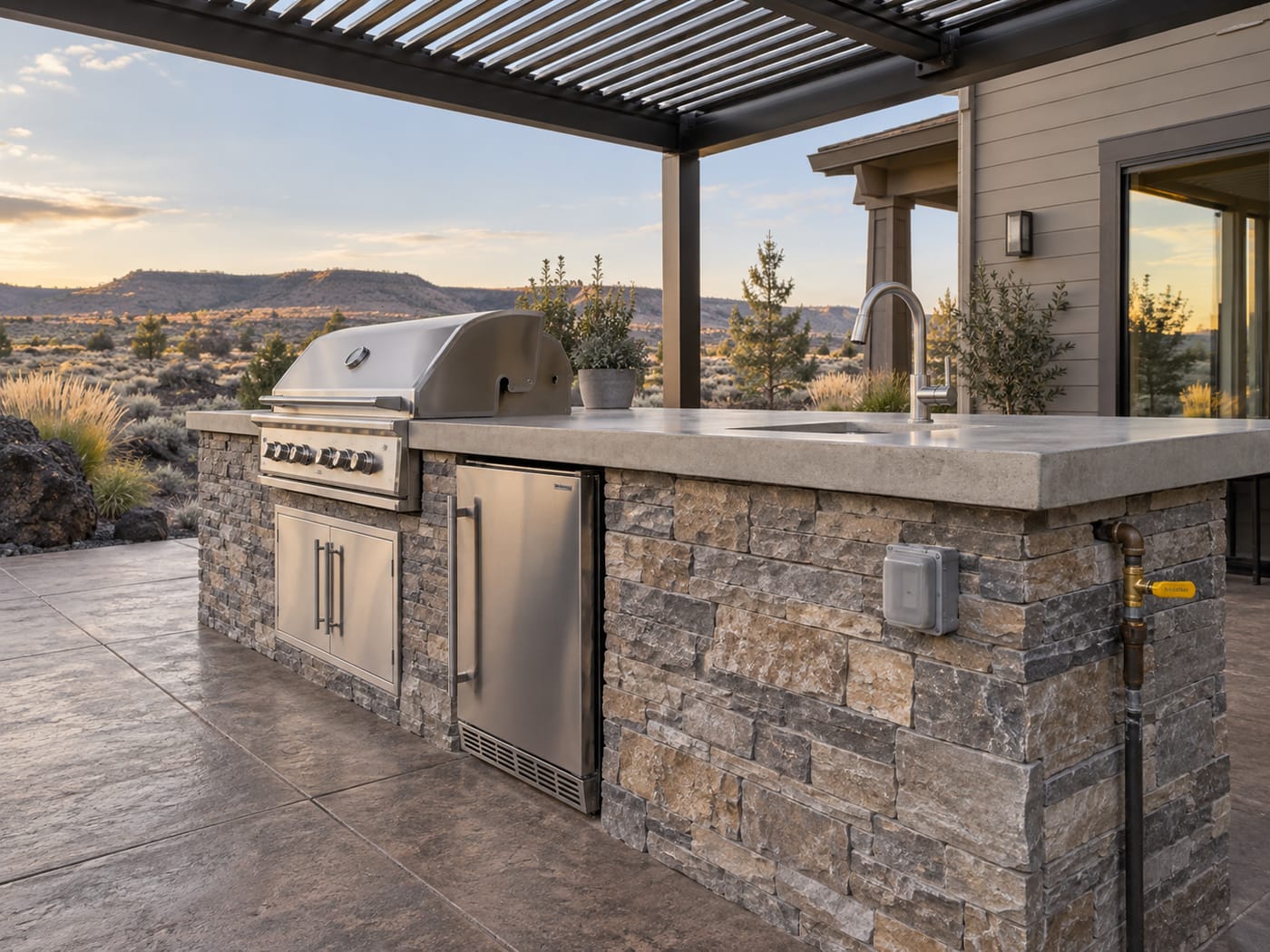
Most people plan an outdoor kitchen from the top down: the grill, the counter, the layout, maybe a pizza oven. The part that actually determines what's possible sits underground and behind the walls.
Gas, power and water are three separate systems, each with its own sizing rules, its own permit, and in the Magic Valley, its own set of winter problems. Get them right at the start and everything built on top is straightforward. Get them wrong and you're cutting concrete to fix it.
Here's what each one involves, and what's specific to building one here.
Start with location, because it sets the budget
Before appliances, before layout, decide where the kitchen sits relative to the house.
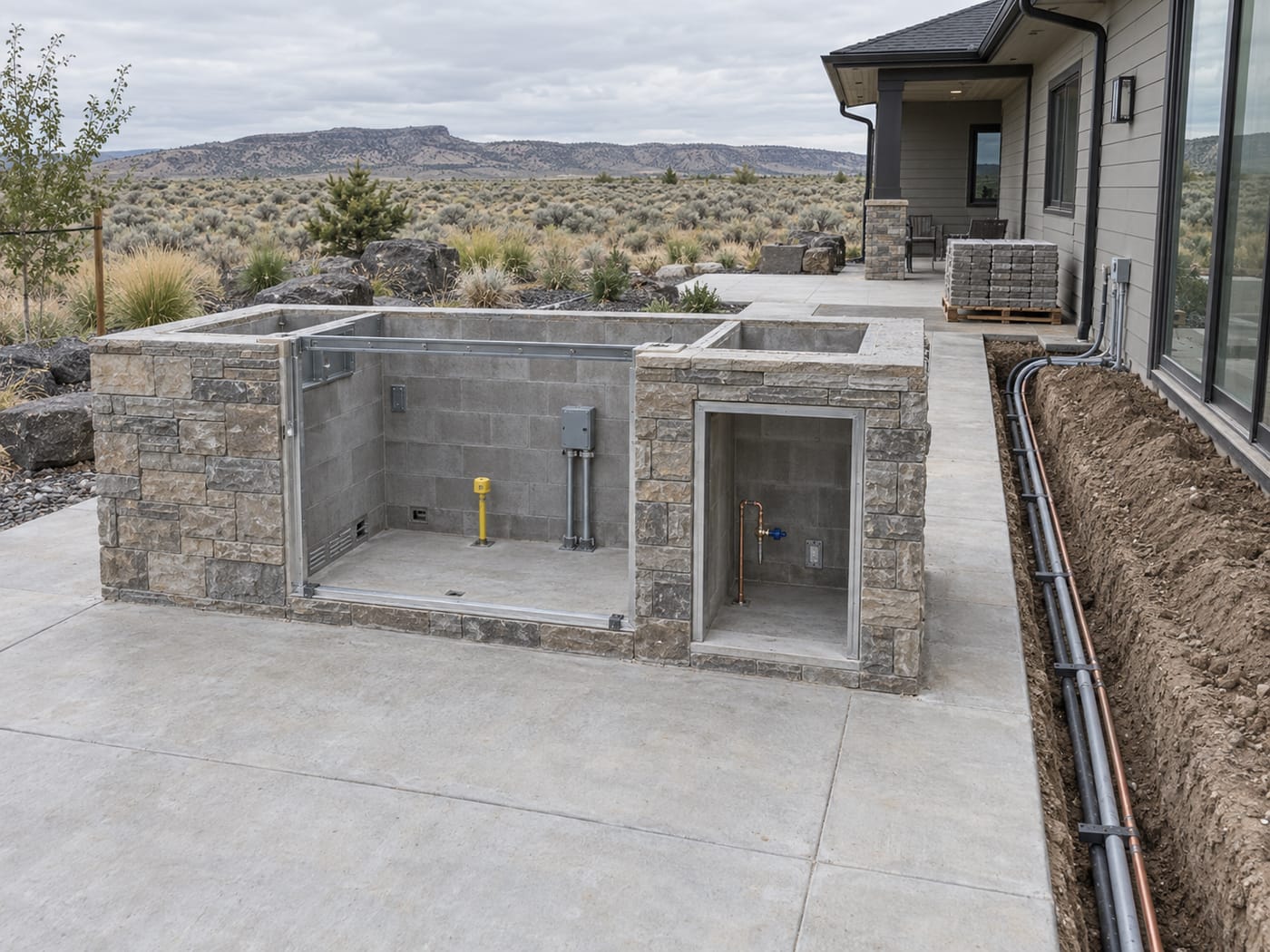
Utilities are far cheaper to run when the kitchen is close to the house, because every service has to travel from your meter, panel or main water line to the island. An island against an exterior wall can often take its plumbing straight through that wall. An island forty feet out in the yard needs a trench for every foot of that distance, and each utility has its own depth and separation requirements in that trench.
A covered patio attached to the house is often the most efficient place to put a kitchen for exactly this reason. It also protects the appliances, which matters more here than in milder climates.
Gas
A built-in grill or side burner on a permanent line needs a dedicated gas run from the home's supply to the appliance location. Three things govern it.
Sizing. The line has to be sized for the total BTU load of every gas appliance it serves, running at the same time. A grill, a side burner and a fire feature on one line add up quickly, and an undersized line produces weak flames at the far end. This is why appliance cut sheets showing BTU ratings get submitted with the permit rather than figured out afterward.
Shutoffs. Each gas appliance gets its own shutoff valve at the kitchen, so one unit can be serviced or disconnected without shutting down everything else.
Testing. The line is pressure tested for leaks before the final inspection is signed off.
Natural gas or propane. If the house already has natural gas, it's usually the better choice: unlimited supply, no tanks to swap, and lower operating cost. Propane works well where natural gas isn't available.
The permit distinction. A grill running off a standard portable propane tank, the kind you'd use with a freestanding grill, generally doesn't need a gas permit. The line is drawn at a permanent hard-line connection. Once gas is plumbed in, it's permitted work.
Under a cover. If the kitchen sits beneath a patio cover and includes a powered vent hood, that can bring a mechanical permit into the picture as well, on top of the gas permit. Kitchens built under an existing or new pergola should plan for that from the start. If a fire feature is also part of the design, see our guide on putting a fire pit under a pergola for the clearance and ventilation side of the same question.
Power
Refrigerators, ice makers, lighting, outlets for small appliances, and anything electric all need power, and outdoor electrical work has its own rules.
GFCI protection. Every outdoor receptacle needs ground-fault circuit interrupter protection, which cuts power almost instantly if it detects current leaking where it shouldn't. That protection can live in the receptacle itself or in a GFCI breaker at the panel. Outdoor kitchens combine electricity, water and metal surfaces, which is exactly the situation GFCI exists for.
Weather-resistant devices. Outdoor receptacles use weather-resistant rated devices with in-use covers that stay closed while something is plugged in.
Circuits. A common pattern is two 20-amp circuits for general use and small appliances, plus dedicated circuits for refrigeration or an ice maker, and separate circuits for heaters or anything else that draws heavily.
Panel capacity. Total load decides whether the kitchen can run off the main panel. As a rough guide, a basic kitchen with a gas grill, a small refrigerator and some lighting might need around 40 to 60 amps and can often be served from the house panel. Mid-size kitchens in the 60 to 80 amp range often benefit from a dedicated 100-amp subpanel near the kitchen. Large kitchens with multiple refrigeration units, electric cooking and extensive lighting can need 100 to 125 amps or more. The actual number comes from a load calculation on your specific appliances.
Underground runs. Buried cable and conduit have their own depth requirements, which is part of why trench planning matters.
The permit distinction. Plugging a refrigerator into an outdoor GFCI outlet that already exists usually doesn't require an electrical permit, because nothing new is being built. Running any new circuit, installing new outlets, adding hardwired lighting or connecting hardwired appliances does.
Water
This is the section that's genuinely different in the Magic Valley, because the problem isn't getting water to the sink. It's keeping it from destroying the plumbing every winter.
Depth. Supply lines are buried below the frost line, the depth to which ground freezes. In both the City of Twin Falls and Twin Falls County, the published frost depth is 24 inches.
Where the shutoff goes. This is the detail that matters most. The shutoff valve for the kitchen's water belongs inside the heated part of the house, with a drain on the kitchen side of that valve, still indoors. In the fall you close the valve, open the drain, and empty the line. Pressurized air can be used to push out any remaining water, the same approach Magic Valley homeowners already use to winterize irrigation systems.
Frost-proof fixtures. A frost-proof faucet places its actual shutoff valve inside warm space, so the part exposed outdoors holds no standing water to freeze.
Materials. Buried and exterior runs use pipe rated for that use. PEX with an insulating thermal sleeve is a common choice for its combination of cost, freeze tolerance and ease of installation. Buried copper is also used. Any above-ground section needs to be UV-resistant or protected.
Backflow prevention. The installation should include a backflow prevention device so water from the outdoor system can't flow back into the home's drinking water supply.
Hot water, or not. Many outdoor kitchens run cold water only, which is cheaper and simpler. If you want hot water for cleanup, the choice is usually between running a hot line from the house or installing an on-demand water heater at the kitchen, and it's worth pricing both.
A garden hose isn't a plumbing system. A hose can feed a sink temporarily, but it doesn't meet plumbing code for a permanent installation, and it gives you no hot water.
Drainage: settle this before anything else
Supply is the easy half of an outdoor sink. The harder question is where the wastewater goes.
Options typically include tying into the house's sanitary sewer or directing water to a dry well or similar dispersal system. Which of those is allowed depends on the jurisdiction, and some jurisdictions require a sanitary sewer connection for any sink that will handle food waste. Since an outdoor kitchen sink almost always does, assume the requirement exists until your building department tells you otherwise.
The answer changes your trench, your cost, and possibly your layout, since a sewer tie-in means routing the drain back toward the house with enough slope to flow. It's the single utility decision worth confirming in writing before the design is finished. Inside city limits, City Building Safety at (208) 735-7238 is the place to ask.
Drain lines also need a trap and proper slope to avoid standing water, clogs and odor, and in winter, water left sitting in a trap can freeze. Draining it, or adding RV-type antifreeze, is part of the fall shutdown.
Winter shutdown is part of the design
In the Magic Valley, an outdoor kitchen is designed for a winter it has to survive, not just a summer it gets used in.
A well-planned system makes shutdown quick: turn off the water at the indoor valve, drain the line, open the outdoor faucet so remaining water escapes, clear the trap, empty and clean the refrigerator, and shut off the gas. Whoever installs the plumbing should walk you through the fall shutdown and the spring opening in person, not hand you a sheet of instructions.
If a system is hard to winterize, it gets winterized badly, and the damage shows up in April.
Permits: who issues what
Here's where the Twin Falls city line matters again.
Inside Twin Falls city limits, the city requires a permit for all electrical, plumbing, mechanical and gas work, with no size threshold and no exceptions, and the city inspects those trades itself. A fixed island with utilities is also generally treated as a structure. Building Safety is at (208) 735-7238.
Outside city limits, it splits. Twin Falls County Community Development Services handles the structure, at (208) 734-9490. Gas, plumbing and electrical go to the state through the Idaho Division of Occupational and Professional Licenses, at (208) 334-3233, with inspection requests at (208) 332-4700. Holding a county building permit doesn't remove the need for the state trade permits.
Who pulls them. Your licensed contractor. DOPL requires contractors to obtain permits in their own name, and homeowner permits exist only for homeowners doing the work themselves on their own residence. And when required work is completed without a permit, DOPL issues an enforcement permit at double the original fee.
For the broader permit picture, see our guide on patio cover permits in Twin Falls.
What this means for your plan
Before you choose appliances, answer four questions:
- Where will the kitchen sit relative to the house? This drives trench length and most of the utility cost.
- Natural gas or propane, and what's the total BTU load? This sizes the gas line.
- What needs power, and how much? This decides whether the main panel can carry it or a subpanel is needed.
- Where does the sink drain, and how will it be winterized? This is the question most likely to change the design.
Those four answers turn a wish list into a buildable plan.
Plan the part you can't see first
A free design consultation covers your layout, your appliances, where your utilities can realistically run, and what your address requires for permits. We handle gas, electrical, plumbing coordination, permitting and inspections in-house.
Book a Free Design Consultation or call (208) 731-1729
Frequently asked questions
Do I need a permit for an outdoor kitchen in Twin Falls? Almost always, if utilities are involved. Inside city limits, any electrical, plumbing, mechanical or gas work requires a permit with no size exemption. Outside city limits, the structure is permitted through Twin Falls County and the gas, plumbing and electrical through the state. A freestanding grill on a portable propane tank plugged into an existing outdoor outlet is the main situation where no new permit may be needed.
How deep does an outdoor kitchen water line need to be in Twin Falls? Below the frost line, which the City of Twin Falls and Twin Falls County both publish as 24 inches. Just as important is where the shutoff sits: inside the heated house, with a drain so the line can be emptied before winter.
Can I drain my outdoor kitchen sink into the yard or a dry well? It depends on the jurisdiction, and some require a sanitary sewer connection for sinks that handle food waste. Confirm with the building department before finalizing your design, since the answer can change your trench route and cost. Inside city limits, call City Building Safety at (208) 735-7238.
Natural gas or propane for an outdoor kitchen? Natural gas if your house already has it: no tanks to refill and lower operating cost. Propane is the practical choice where natural gas isn't available. Either way, a permanent line needs to be sized for the combined BTU load of every connected appliance.
Does an outdoor kitchen need its own electrical panel? Not always. A basic kitchen with a gas grill, a small refrigerator and some lighting can often run from the main house panel. Larger kitchens with multiple refrigeration units, electric cooking or heaters often need a dedicated subpanel. A load calculation on your actual appliances settles it.
Do all outdoor kitchen outlets need GFCI? Yes. Outdoor receptacles require ground-fault protection, either at the outlet or at the breaker, along with weather-resistant devices and in-use covers.
Do I need hot water at an outdoor sink? No, and many outdoor kitchens skip it. If you want it, compare running a hot line from the house against an on-demand heater at the kitchen.
How do I winterize an outdoor kitchen? Shut off the water at the indoor valve, drain the line, open the outdoor faucet, clear or protect the drain trap, empty the refrigerator, and shut off the gas. A properly designed system makes this a short job. Your installer should show you how in person.
This article is general guidance for the Twin Falls area, not a code ruling. Requirements vary by appliance, load, site and jurisdiction, and differ between the City of Twin Falls and Twin Falls County. Confirm specifics for your project with City Building Safety at (208) 735-7238, Twin Falls County Community Development Services at (208) 734-9490, or Idaho DOPL at (208) 334-3233 before you build.