
Fire Table vs. Fire Pit vs. Outdoor Fireplace in Idaho
A fireplace is a wall, a fire pit is a circle, a fire table is furniture. How the heat pattern, your view, the wind and your patio cover decide which one actually fits, plus what each one costs.
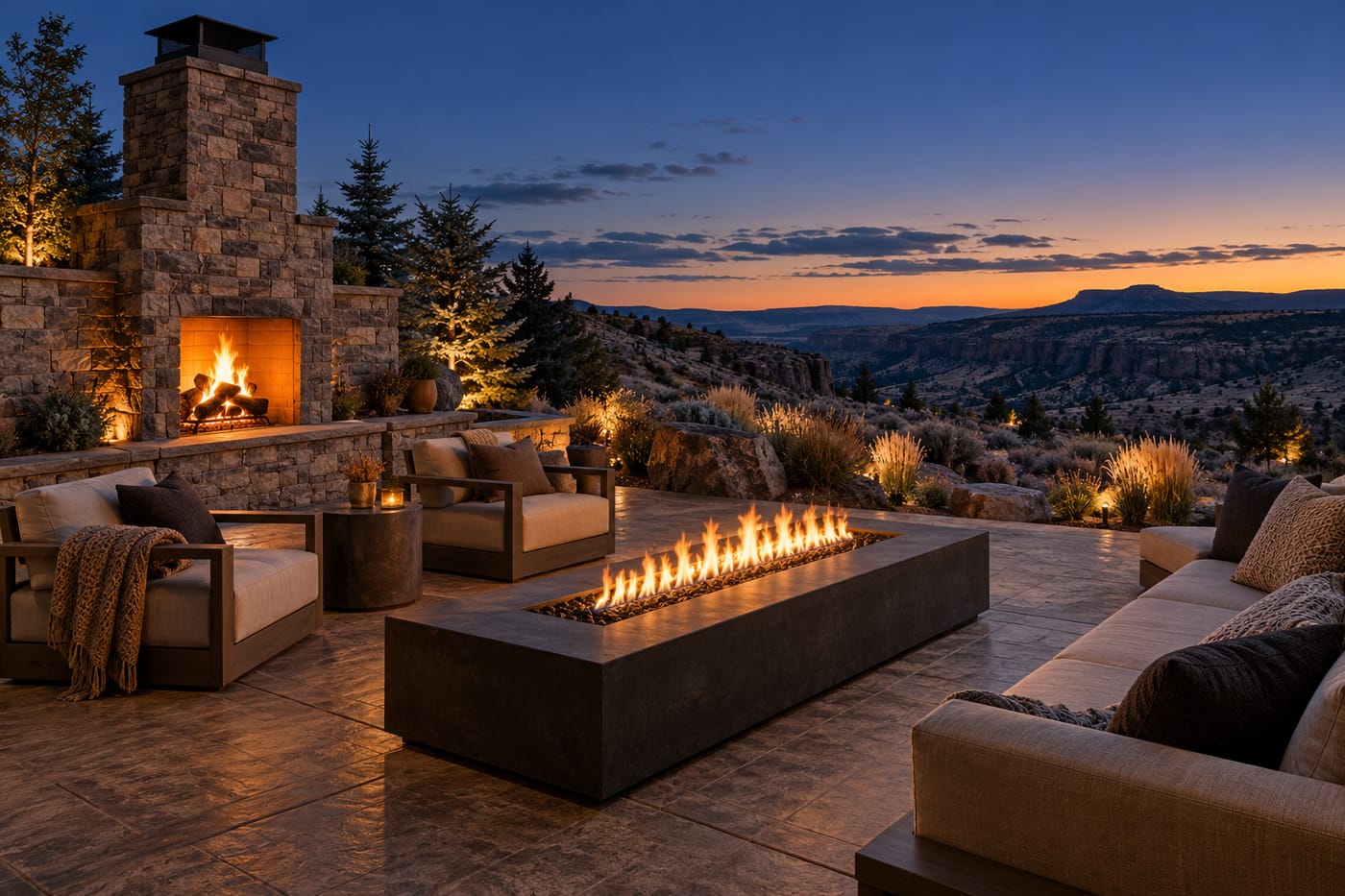
TL;DR
- A fire table is furniture. It has a ledge for drinks and plates, suits sofas and dining seating, and is almost always gas.
- A fire pit is a circle. Little or no usable surface, chairs all the way around, campfire feeling. Wood versions mean ash.
- An outdoor fireplace is a structure. Roughly 6 to 10 feet plus a chimney, against a wall or property line, versus 3 to 5 feet for a pit.
- Heat behaves differently. A fireplace throws heat forward out of one opening. A pit or table radiates 360 degrees, so everyone gets some and nobody gets much.
- A fireplace is a wall, which means privacy and a backdrop, and also a blocked view. On a rim property that is the whole decision.
- Under a covered patio, a fireplace usually does not work. Chimney clearance rules it out. A fire table generally does work.
- Cost: built-in gas features commonly run $1,500 to $8,000 installed, while custom fireplaces run $8,000 to $18,000 and up.
Three products, one word. People call all of them a fire pit, then end up with something that does not fit how they actually use the patio.
The useful question is not which looks best in a photo. It is what you want the fire to do: give people somewhere to sit and set a drink, pull a group into a circle, or anchor one end of the space and throw real heat at it. Those are three different answers.
What actually separates them
A fire table has a ledge or tabletop surrounding the burner. That surface is the whole point, because it means drinks, plates and phones have somewhere to go. Fire tables sit at a height that works with outdoor sofas, lounge chairs or dining seating, and they are typically run on natural gas or propane, so cleanup is minimal.
A fire pit has little or no usable surface. The flame is the centerpiece and people sit in a ring around it, which is the traditional campfire arrangement. Wood-burning versions deliver the strongest radiant heat and also require ash removal and, under a cover, create problems we cover below.
An outdoor fireplace is not a bigger fire pit. It is a built structure with a firebox and a chimney, typically 6 to 10 feet of wall plus the chimney above it, where a fire pit occupies 3 to 5 feet across. It belongs against a wall, a fence line or a property edge, and it changes the architecture of the yard rather than furnishing it.
One thing worth knowing before you shop: burner size and BTU rating affect the heat you actually feel more than which of these three labels the product carries.
Heat: a circle or a direction
This is the difference that decides whether the thing gets used in October.
A fireplace sends heat forward, out of a single opening. One group sitting in front of it gets focused, directional warmth. Everyone else gets nothing.
A fire pit or fire table radiates in all directions. Everyone seated around it gets some heat, and nobody gets the concentrated warmth a fireplace delivers to the seats in front of it.
So the question becomes how you actually gather. If your evenings involve six or eight people spread around a seating group, the 360 degree version serves more of them. If it is usually two or four of you wanting to stay out past dark in November, a fireplace puts more heat where you are sitting.
The view, and the wall
Here is the tradeoff that matters most on Magic Valley properties, especially anything near the rim.
An outdoor fireplace acts as a wall and a backdrop. That gives you privacy and a strong architectural anchor, and it blocks whatever is behind it. If your patio looks out over the canyon or across open ground toward the mountains, a fireplace placed badly removes the reason you bought the house. Placed well, against the neighbor side rather than the view side, it does the opposite and screens what you did not want to look at.
A fire table or fire pit sits low and keeps sight lines open in every direction. You keep the view. You also get no screening from a neighbor's window and no barrier at all.
On wind, be realistic rather than hopeful. A fire pit in an exposed spot generally needs a wind guard, and manufacturers of fireplaces commonly recommend a windbreak or landscaping where steady wind hits the unit. A fireplace is a wall and will do something, but do not buy one expecting it to solve a wind problem on an exposed lot.
If you have a covered patio, this narrows fast
A fireplace and a roof are usually incompatible, and the reason is the chimney.
Manufacturers specify substantial clearance above a fireplace chimney, with figures in the range of several feet and one manual calling for 4 to 6 feet above the chimney top. Put that under a pergola or a solid cover and the numbers rarely work. It is not impossible on a very tall structure, but it is the exception.
A gas fire table under a cover is a different story and is usually workable with the right clearances and ventilation. We go through that in detail in our guide to putting a fire feature under a pergola, including the ventilation question that comes up when a louvered roof is closed.
Wood under any cover is the weakest option of all. Sparks, unpredictable flame height and soot accumulating on the underside of your structure.
So if the fire is going under the roof, you are realistically choosing between a gas fire table and a built-in gas fire pit. If it is going out in the open yard, all three are on the table.
What each one costs
2026 installed figures, as a planning guide rather than a quote.
Fire pits and tables. A portable propane table or steel bowl runs $60 to $700 and is furniture rather than a project. A contractor-built stone wood pit runs $1,500 to $4,500. A built-in gas feature with a line run is commonly $1,500 to $8,000, and that is the category most of our fire work falls into at the lower end.
Fireplaces. A prefab kit with stone veneer runs $3,000 to $6,000. Custom masonry wood-burning runs $8,000 to $15,000. Custom with a gas starter runs $10,000 to $18,000. A large integrated focal wall runs $15,000 to $30,000. National averages land around $1,200 for pits and $7,500 for fireplaces.
Our published range is $4,000 to $18,000, which maps onto that almost exactly: a built-in gas feature at the bottom, a custom fireplace with a gas starter at the top.
Two things move the number more than the product type does. Whether a permanent gas line has to be run, and whether the feature is masonry built on site or a unit set into a surround.
One note on resale
If that factors into the decision: an outdoor fireplace typically recoups somewhere around 50 to 70 percent of its cost, strongest in markets where people actually live outside. A built-in fire pit adds a smaller bump. A portable unit adds essentially nothing, because it leaves with the owner when they move.
That is an argument for building in rather than for spending more. A built-in gas fire table at the lower end of the range stays with the house and gets used every week. A fireplace you chose for resale and never sit at is the worse purchase.
How to decide
Answer these four and the choice usually makes itself.
Where is it going? Under a cover means a gas table or built-in pit. Open yard means anything.
What does the view look like? If there is one worth keeping, a fireplace needs to go on the non-view side or not at all.
How do you gather? Larger groups spread around a seating area favor 360 degree heat. Two to four people wanting real warmth favor directional.
How late in the year do you want to use it? The further into the shoulder season you want to push, the more a fireplace or a high-BTU built-in earns its cost.
Let's walk your space
Which fire feature fits is usually obvious once somebody stands in the yard, looks at where the view is, where the wind comes from and how you actually sit. A free design consultation covers all of it, plus the gas and permit side.
Book a Free Design Consultation or call (208) 731-1729
Frequently asked questions
What is the difference between a fire pit and a fire table? A fire table has a surrounding ledge or tabletop for drinks and plates and sits at a height suited to sofas, lounge chairs or dining seating. A fire pit has little or no usable surface and is built for a ring of chairs around the flame. Tables are almost always gas; pits are commonly wood or gas.
Which one puts out more heat? It depends more on burner size and BTU rating than on the category. The real difference is the pattern. A fireplace sends focused heat forward out of one opening, while a pit or table radiates 360 degrees so everyone gets some and nobody gets a lot. Wood-burning pits produce strong radiant heat but bring smoke, sparks and ash.
Can I put an outdoor fireplace under a covered patio? Usually not. Manufacturers call for significant clearance above the chimney, commonly several feet, and a roof rarely leaves room for it. A gas fire table under a cover is generally workable with proper clearances and ventilation. Check your unit's manual and confirm with the fire marshal.
How much does an outdoor fireplace cost compared to a fire pit? Built-in gas fire features commonly run $1,500 to $8,000 installed. Fireplaces start around $3,000 to $6,000 for a prefab kit with veneer and run $8,000 to $18,000 for custom masonry, with large focal walls going higher. Running a permanent gas line and choosing site-built masonry are the two biggest cost drivers.
Will a fireplace block the wind on my patio? Partially, and do not count on it as a solution. It acts as a wall and backdrop, but manufacturers themselves recommend a windbreak or landscaping where steady wind hits the unit. On an exposed lot, screens or a wind-aware layout do more for comfort than the fire feature will.
Costs in this article are 2026 national installed figures offered as planning guidance, not quotes. Clearance and installation requirements vary by product, so follow your appliance's instructions and confirm local requirements with the City of Twin Falls Fire Marshal at (208) 735-7232 or your local rural fire district before you build.