
Motorized Patio Screens in Idaho: Bugs vs. Sun vs. Wind
An insect screen will not fix a hot west patio, and no mesh is a privacy wall once your lights are on. The four jobs patio screens actually do, what openness factor trades away, and how to choose.
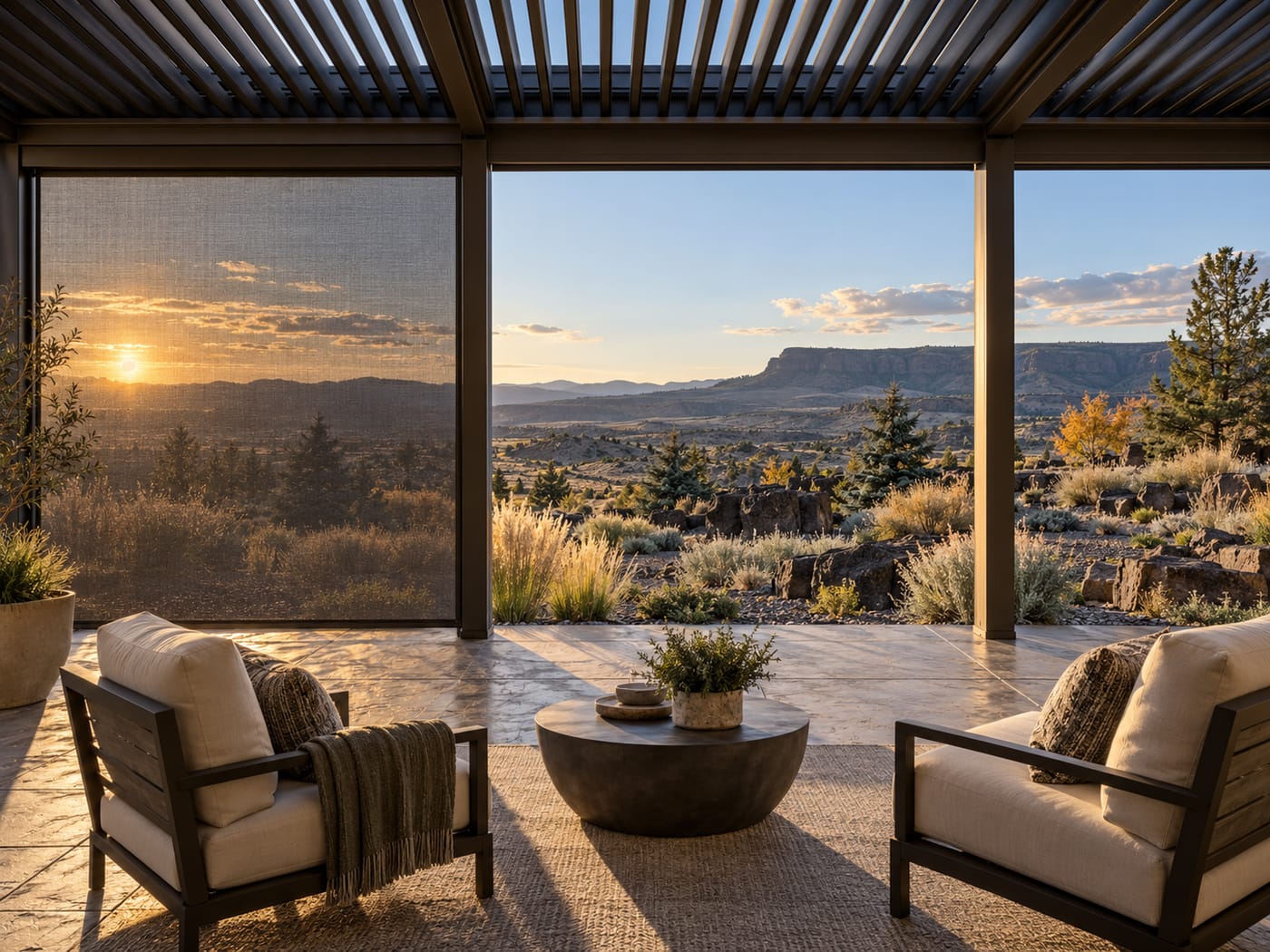
TL;DR
- "A screen" is not one product. The mesh is engineered for a specific job, and the wrong one solves the wrong problem.
- Insect mesh keeps out flies, mosquitoes and no-see-ums while maximizing airflow. It does almost nothing for a hot west-facing patio.
- Solar mesh blocks a large share of UV and cuts heat and glare. Progressive publishes a range of 70 to 97 percent UV blocked depending on the fabric.
- Vinyl panels are the year-round option, closing the space against wind and cold rather than filtering light.
- Openness factor is the dial. Roughly 1 percent gives the most daytime privacy and the least view, 10 percent gives the most view and the least privacy.
- Screens are a daytime privacy product. Once your lights are on after dark, the effect reverses and people outside can see in.
- In Twin Falls, a motorized screen needs a permit, because the city requires one for all electrical work with no size exemption.
Most people call us about screens using one word for four different problems. Bugs. Sun. Wind. Privacy.
Those are not the same complaint, and they do not have the same answer. The mesh that keeps no-see-ums off your dinner is not the mesh that makes a west-facing patio usable at six in the evening, and neither one turns your patio into a private room after dark.
Screens are the most affordable thing we install, generally running $3,500 to $12,000 per opening depending on size and motor. They are also the easiest thing to buy wrong. Here is how to pick the right one.
Start with the problem, not the product
Four jobs, four different answers.
Bugs. Insect mesh is a tight weave designed to stop flies, mosquitoes, small insects and no-see-ums while letting as much air through as possible. The whole design goal is airflow, because a bug screen that kills the breeze makes the space worse than it was. If your only complaint is that you cannot eat outside in the evening without company, this is your product, and you do not need to pay for anything else.
What it will not do is meaningfully cool the space. Insect mesh is built to be open.
Sun, heat and glare. Solar mesh is a different fabric entirely. It is woven to intercept solar radiation before it reaches you, and the Progressive line publishes UV blockage in the range of 70 to 97 percent depending on the fabric chosen. This is the answer to a patio that bakes from four to seven in the evening, to furniture fading, and to glare that makes a screen or a conversation unpleasant.
It also provides some insect resistance and some wind reduction, which is why it tends to be the most common choice when someone has more than one complaint.
Wind. This is the Magic Valley problem nobody puts on their list until they have lived with it. Solar fabrics cut wind to a degree. Vinyl panels close the opening properly, which is what you want if the goal is using the space in shoulder season rather than filtering a summer afternoon.
Privacy. Real, but with a caveat large enough that it gets its own section below.
Openness factor: the number that decides everything
Once you know the job, openness factor is how you tune it.
Openness is simply the percentage of open space in the weave. Lower numbers mean a tighter fabric that blocks more. Higher numbers mean a looser fabric that preserves the view. It trades privacy and glare control against visibility, directly and unavoidably.
As a general guide:
- 1 percent gives the best daytime privacy and the strongest glare control, with limited view through. This is the choice when the sun is genuinely punishing.
- 3 percent keeps a good deal of daytime privacy and high glare control, with a moderate view.
- 5 percent is the balance point, with usable privacy, good view, and solid glare control.
- 10 percent preserves the view very well, with the least privacy and the least glare control.
There is no setting that gives you a wide-open view and strong privacy at the same time. Anyone who tells you otherwise is selling.
One useful detail: darker fabrics tend to make the view through the mesh look clearer and make the screen itself less visually present. Lighter fabrics bounce more light back but can look hazier from inside.
The privacy caveat worth knowing before you buy
Here is the part that does not appear in most sales conversations.
Solar screens are a daytime product. During the day, the light outside is brighter than the light under your cover, so the mesh reads as opaque from the outside and transparent from the inside. That is the effect people are buying.
After dark, that reverses. Once your lights are on and the yard is dark, light passes outward through the same mesh, and people outside can see in. This holds at any openness percentage. A 1 percent fabric gives you more daytime coverage than a 10 percent fabric, but none of them are a wall at nine in the evening.
If the goal is genuine evening privacy, the honest answers are vinyl panels, a solid privacy wall, or managing your own lighting rather than expecting mesh to do it. We would rather tell you that up front than have you discover it the first night you use the space.
What the Magic Valley actually calls for
Your exposure usually settles the choice faster than a catalog does.
A west or south-facing patio is a sun and glare problem first. That is solar mesh, and probably a lower openness number than you would instinctively pick, because the late afternoon sun here is low and direct and a loose weave will not stop it.
A patio near water, irrigation or heavy planting is an insect problem, and insect mesh with good airflow is the efficient answer.
An exposed lot, which describes a lot of properties out toward the rim and on open ground, is a wind problem. Both the city and the county design to a 115 mph wind speed, and while your screens are not structural, wind is the thing most likely to make an outdoor room unusable on an otherwise pleasant evening.
Most people have two of these. That is normal, and it is usually solved by choosing the fabric that handles the dominant problem and accepting partial help on the secondary one, rather than trying to buy a screen that does everything.
How they attach, and what that means
Motorized screens retract into a low-profile housing when not in use, so the opening reads as open when you want it open. They run on a remote or an app, and wind-sensor automation is available so the system retracts on its own rather than waiting for someone to notice.
Progressive's MagnaTrack system uses rare earth magnets in the side tracks and is designed to flex under wind pressure rather than fight it, which the manufacturer credits with eliminating 98 percent of common service issues. Custom sizes go up to 30 feet wide by 20 feet tall, with limitations. Six standard extrusion colors are available with custom RAL matching, and the published manufacturer warranty is lifetime on the aluminum, 15 years on the screens and 5 years on the motors.
Screens can be added to a new pergola or retrofitted to an existing covered patio. If a pergola is in your future but not your budget this year, tell your builder during design anyway, so the track channel and conduit get built in rather than retrofitted later. The same logic applies to lighting and heat. We cover how the structure side works in our guide to how motorized louvered pergolas work.
Permits, briefly
Inside Twin Falls city limits, a permit is required for all electrical work with no size threshold and no exceptions. A motorized screen is electrical by definition, which settles the question before anyone measures the opening.
Outside city limits, electrical routes to the state through the Idaho Division of Occupational and Professional Licenses rather than through Twin Falls County. The full breakdown is in our guide to patio cover permits in Twin Falls.
The questions to ask before you sign
- Which fabric is being quoted, and which of the four jobs is it engineered for?
- What openness factor, and what does that mean for the view from where I actually sit?
- What does it not do? A quote that claims one screen solves sun, bugs, wind and privacy equally well is describing a product that does not exist.
- Who handles the electrical permit?
- What is covered, and for how long, separating the aluminum, the fabric and the motor, since those are often different terms.
Let's figure out which problem you're actually solving
Fifteen minutes standing on your patio at the time of day it bothers you tells us more than any catalog. A free design consultation covers your exposure, your openings, the right fabric for the job, and what your address requires.
Book a Free Design Consultation or call (208) 731-1729
Frequently asked questions
Will an insect screen also block the sun? Not meaningfully. Insect mesh is engineered around airflow, which means an open weave, which means solar radiation passes through. If your complaint is heat or glare rather than bugs, you want solar fabric instead.
Will a solar screen keep bugs out? Partially. Solar fabrics are tighter than insect mesh in some respects and do offer some insect resistance, but a dedicated insect screen is built for that job. If bugs are your main problem, say so, because it changes the fabric.
Do motorized screens give you privacy? During the day, yes, to a degree set by the openness factor. After dark with your lights on, the effect reverses and people outside can see in. Mesh is a daytime privacy product. For evening privacy, look at vinyl panels, a solid privacy wall, or how you light the space.
What openness factor should I choose? It depends on whether you value the view or the shade more. Roughly, 1 to 3 percent prioritizes privacy and glare control, 5 percent balances, and 10 percent prioritizes the view. Sit on your patio at the hour that bothers you before deciding, because the answer is usually obvious once you are standing there.
How much do motorized screens cost in the Magic Valley? Generally $3,500 to $12,000 per opening, varying by size and motor. Screens are typically the most accessible thing we install, and they are a common first phase for homeowners who plan to add a cover or a fire feature later.
Do motorized screens handle wind? Progressive's MagnaTrack system is built to flex under wind pressure rather than resist it rigidly, and wind-sensor automation can retract the screens on its own. For genuinely closing a space against wind rather than filtering it, vinyl panels are the stronger answer.
Can I add screens to a patio cover I already have? Usually yes. Screens can be added to a new pergola or retrofitted to an existing covered patio, though the existing structure determines what is practical. If you are building a cover now and want screens later, have the track channel and conduit built in during construction.
Do I need a permit for motorized screens in Twin Falls? Inside city limits, yes, because any electrical work requires a permit regardless of size. Outside city limits, the electrical goes through the state rather than the county.
This article is general guidance for the Twin Falls area. Fabric specifications, openness options and performance figures vary by product and manufacturer, so confirm the specific fabric being quoted for your project. For permit requirements, contact City Building Safety at (208) 735-7238 or Twin Falls County Community Development Services at (208) 734-9490.